

🔮 "There Isn't Going to Be Another Supreme Leader"
We monitor the Iran situation with a team of competitive forecasters


“Belikewater” is the pseudonym of a professional forecaster with Sentinel Global Risks Watch, a nonprofit forecasting team focused on tail risks.
When we first spoke in June 2025, less than a week before Trump first hit Iranian nuclear sites in “Operation Midnight Hammer,” she gave Khamenei just a 15% chance of surviving the year in power.
While the timeline was off by a few weeks, Belikewater is known for anticipating Trump’s most aggressive moves when the conventional wisdom is hammering the TACO trade.
Four days into the Iran war, whether the Iranian regime survives is deeply uncertain. Forecasting research shows that aggregating forecasters with different methods and temperaments, known as “ensemble forecasting,” produces better outcomes than any one analyst.
The Oracle invited belikewater, and four other members of the Sentinel hive mind, for a panel interview on what happens next in Iran. The members:
Belikewater, Sentinel’s most hawkish voice.
Vidur Kapur, described by teammates as machine-like in his focus on the motivations and personalities of the key actors
Nuño Sempere, Sentinel’s founder, the base-rate maxi of the group
Misha Yagudin an AI founder currently in Tel Aviv, previously cofounded the Samotsvety Forecasting team, a predecessor of Sentinel
“Ben” a top-ranked competitive forecaster with a hard science background.
This interview has been edited for length. All answers are their own.
What was Sentinel’s last forecast before the strikes, and what were you thinking on Friday night?

Vidur: The last forecast we made was Monday of last week. We asked whether the US will strike Iran by March 8, by end of March, and by end of June. We were at 38% by March 8, 66% by end of March, and 79% by end of June.
By Friday I was telling some friends this is probably the weekend it’s going to happen. There were lots of embassy evacuations. The reason we expected it at all was the huge US military buildup in the region and Trump explicitly saying he was going for regime change. We still held out some hope that negotiations would succeed.
Nuño: One signal for me was the conflict between the Pentagon and Anthropic because they had this harsh 5 p.m. Friday deadline. Why do you have a very harsh deadline unless you need it urgently? I did post in our channel:
“I just put 2 and 2 together and realized that the Pentagon wants to use Anthropic’s models for something in Iran, maybe identifying military targets to automatically kill them. Otherwise it’s not that urgent.”
More generally, if you can credibly threaten to bomb Iran and kill the leaders, why wouldn’t they take a deal? I also thought the Iranian foreign minister was amazing at drawing things out, hoping Trump loses interest. You see something similar with Russia, where every time Trump gets upset they offer talks to stall.
Ben: I had assumed the US was willing to make a serious economic rapprochement with Iran. There were offers to provide nuclear fuel in perpetuity if Iran gave up its own facilities. These seemed like pretty serious concessions and Iran should be taking them seriously if they’re rational. But it’s hard to view the former Iranian leadership as particularly rational given that they did not manage to convince the US they were serious about a deal.
Nuño: It also seems that maybe the US was not dealing in good faith, making these proposals so that the Iranian leadership would have to meet to agree on whether to take them. They’d be meeting together so they could be bombed. That was a good chess move.
Belikewater: Axios today confirmed that the US and Israel originally planned to attack Iran a week earlier than they did, and that before the strikes, just like last year, the US and Israel wanted to signal there was no imminent strike so that Khamenei and the others would feel safe. It was the same playbook as Operation Midnight Hammer.
Meanwhile we had endless cargo flights coming into the Middle East. And the night before, there was a brief message to cargo planes that came into one of the bases in the Gulf instructing them to spend as little time as possible on the ground, with a statement that no further information could be given at this time. My antennae were going up by Friday night. The only question was when, and it was clear that Iran wasn’t going to negotiate on any of the critical points. So to me it was all but a done deal.
Walk us through the last 48 hours. What surprised you? What were the US and Israel trying to accomplish?
Vidur: It’s difficult to tell what the US objectives are. On one hand Trump said the Iranian people should rise up and seize their freedom. On the other hand there are reports that Trump wants to negotiate with members of the regime, and some Israeli reporting suggests the US even thought about trying to get a ceasefire over the weekend. There’s a lot of contradictory stuff out there.
If I had to guess, he’s willing to cut a deal with members of the regime. I’m a bit below 50% on whether the regime will fall by end of June or end of 2026. I’m trying to correct for recency bias. We saw something similar in Venezuela where they took Maduro out but put his vice president in.
Generally the US has been reasonably good at regime changes when it wants to be over the past century. Libya and Yugoslavia are maybe the best parallels, both air campaigns. With Milosevic he was toppled a bit over a year later. With Gaddafi it was maybe nine months. With Afghanistan and Iraq you had ground forces helping.
Belikewater: It’s clear that the US did not have any major pre-arrangement with a successor figure the way they had with Delcy Rodriguez in Venezuela, because I think we would already know about that by now. They’re clearly winging it more. Sending a message across the country that people should rise up and get rid of the government.
Ben: I was surprised by the reported videos of Trump hacking onto state television to foment a coup. That kind of implies there’s not a plan to negotiate directly and have an immediate successor.
Also, we’re not really used to the US fighting wars that are surprising. We’re used to these long-term managed conflicts in Iraq and Afghanistan. When the US assassinates the head of a major country on the first day of fighting while simultaneously saying they’re negotiating to find a replacement and also pushing for regime change with information warfare, that’s just an unusual thing. But in warfare you’d expect to see things you’re very surprised by, because both sides should be behaving optimally. They should be surprising outside observers. That’s strategic.
Misha: Being in Tel Aviv with all the defensive infrastructure Israel has built feels quite safe. There have been very few direct hits on Israel. I spent a couple of nights at a small bunker downstairs. Today was much quieter than the first day.
One thing I learned early in the first day is that Israel apparently has Iron Beam, a precision laser capable of disabling around 10 drones per minute at a fairly large distance. The current problem with drones and interceptors is that defense is much more costly than offense. A drone can cost tens of thousands to hundreds of thousands of dollars, but with the laser you just spend electricity.
I was also concerned about whether a US aircraft carrier would be hit. If Iran sent a huge swarm of drones at once, you maybe can’t defend against it. This war is already unfavorably viewed especially among Democrats. Losing a major asset would have been a disaster. But this now seems almost nil probability.
What happens to the regime now? Walk us through the scenarios.
Belikewater: I think it’s most likely that the IRGC will remain in power to some extent. But there is almost zero chance we end up with another Ayatollah and clerical control remaining. I don’t think the Islamic Republic is going to continue in any real sense. I could envision a scenario where the Ayatollahs are shuffled off into the back room and given some title, but they don’t retain any actual power.
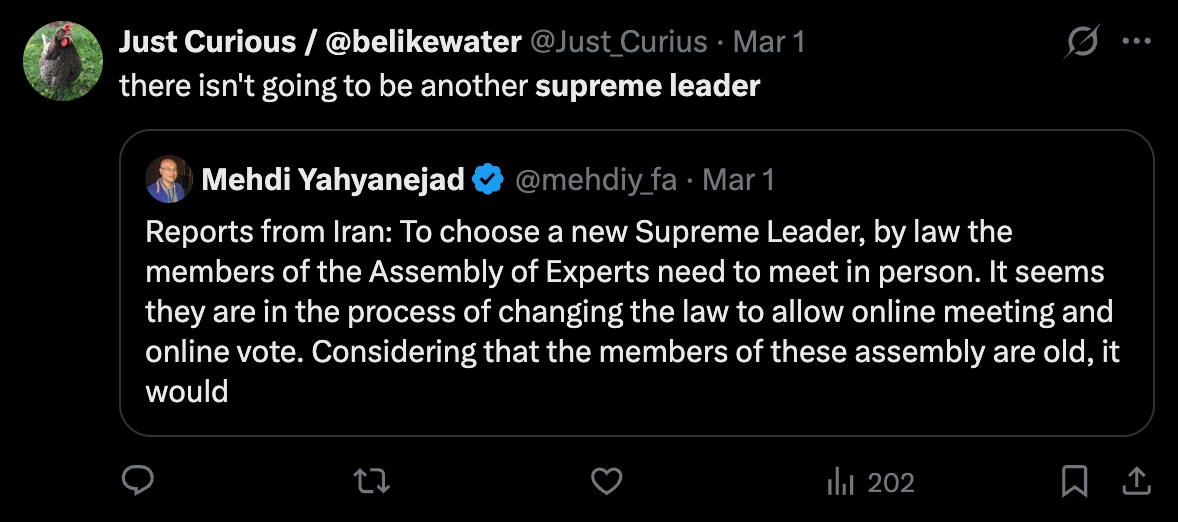
My best bet for who will lead the country is Ali Larijani. He and his brothers are the only ones who can really command enough power across enough domains. He has connections within the political core of the country, the religious core leadership, and the military leadership. He’s one of the only people who has a chance of holding it all together.
Overall, I think it’s most likely that the IRGC remains in some form, maybe with a new name, and we see a shift to secular control. Still a very conservative Muslim country. But clerical authority over the government will be gone.
Ben: I’ll take the opposite side. I still think there’s a very decent chance we don’t see any large-scale shifts and the general structure of the government remains more or less intact, even if the central leadership has to make some serious concessions to stay in power. Maybe the true balance of power shifts back to the more parliamentary and republican pre-revolutionary parts of the government. But as far as the actual structural form of the government, I don’t think we’re likely to see major changes even if there is a more US-favorable leader installed.
Nuño: You can also imagine something at the other extreme. You have a regime that has been closing mosques and there could be widespread preference falsification throughout the country supported by killing lots of protesters. Now you kill the leaders, you deal them a very harsh blow in terms of falsifying their religious beliefs, and the country just shifts. There was a survey back in 2020 showing that 30% of people were irreligious, and only ~40% identified as muslim. If you get 30% atheists or agnostics even under the previous regime, what’s the actual figure now that the leadership has been annihilated?
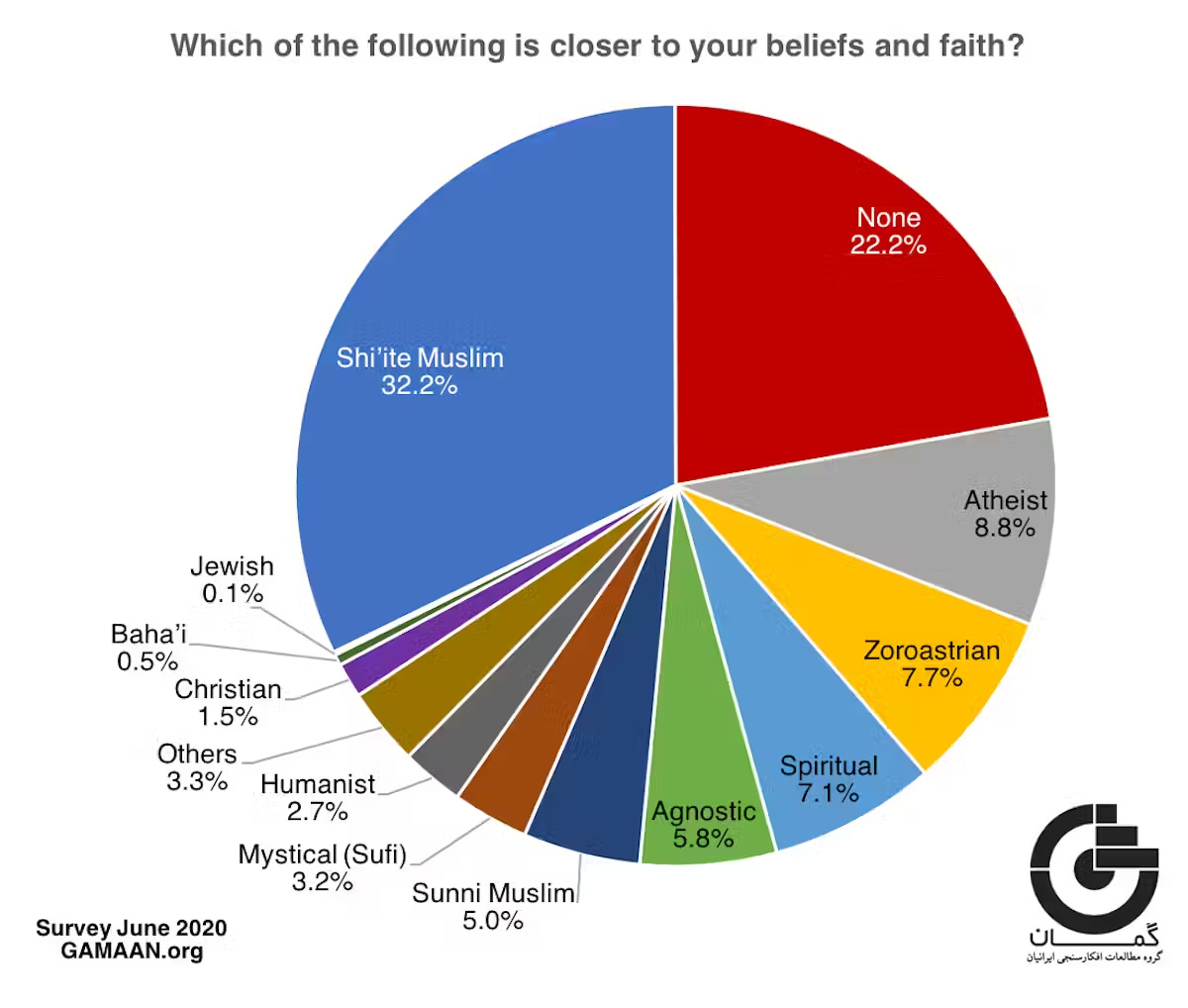
Belikewater: I would caution against concluding that declining mosque attendance equates with declining religiosity. The mosques were also mouthpieces of the government and people may have simply got tired of the mingling between government and religion. In fact I think it’s quite possible we could see mosque attendance grow once those things are decoupled. But certainly not everyone is as conservative as the regime’s version of Islam.
Ben: I’d say the odds of a color revolution, a public uprising where the form of government changes pretty dramatically, are maybe 15%.
Nuño: That’s even a bit higher than I would go, but it’s what Trump is hoping for.
Misha: We did see big protests in Iran following the 12-day war. There is a lot of civil desire for change both economically and politically. And given how successful the US and Israel coalition have been in removing key people in positions of power, they may have removed the people most ruthless and most willing to shoot protesters. This might make the next iteration of protest or a peaceful transition more likely.
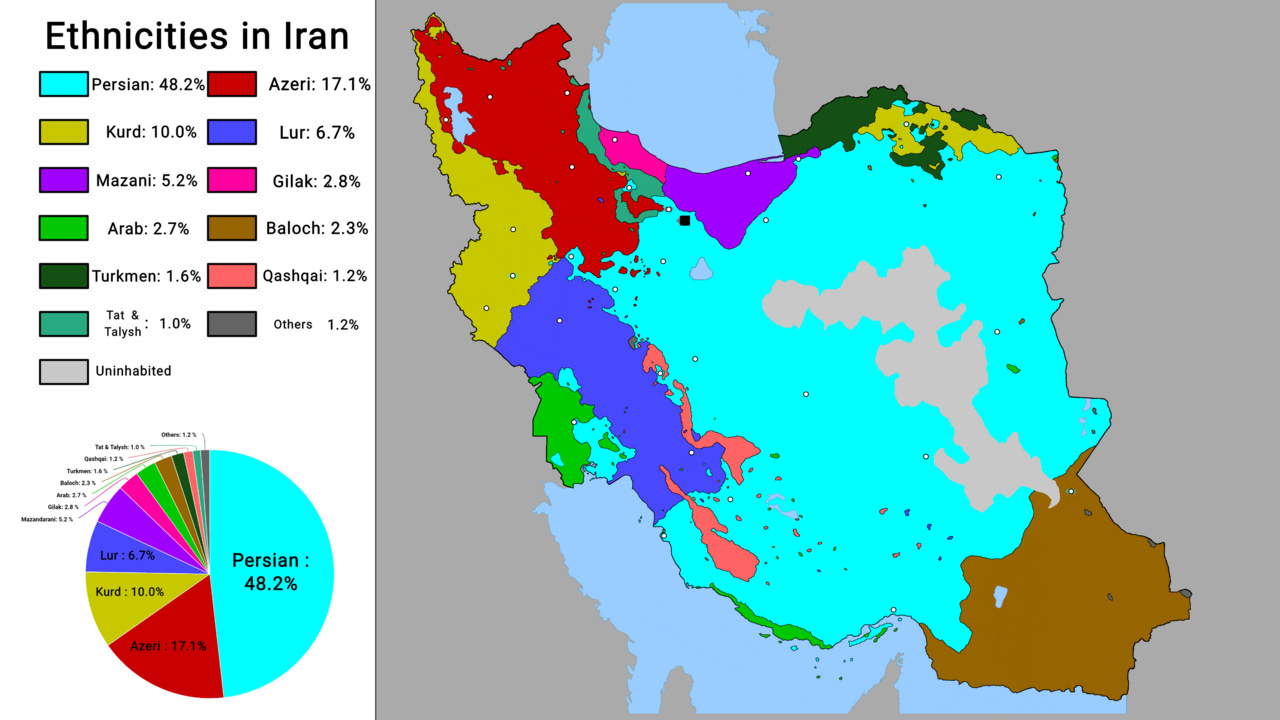
Belikewater: On civil war. I think it’s hard to see what a civil war could actually look like in practice. The country is so fractured. There’s no clear opposition group with any real power. You could have some regional groups, Azeris, Baluchis, Kurds, fighting for autonomy around the edges. Or you could have more conservative factions aligned with the old regime fighting newer ones. But it’s not like there are clear rival power centers with independent armies. The IRGC has entirely subsumed the regular military.
And a giant problem even under a new government is that the economy has been so hamstrung by an enormous level of corruption that if they don’t address that, they’re still going to have massive problems with critical infrastructure. As soon as they drop the pursuit of nuclear weapons and a ballistic missile program, sanctions can go and that provides a tremendous boost. But corruption remains the giant underlying problem.
Let’s move to some specific questions. Will the Iranian Regime fall this year?

Belikewater: That definition is actually not about the IRGC disappearing. It’s about whether the IRGC is still under clerical control. So I think the IRGC will remain but not under clerical control. Almost zero chance we end up with another Ayatollah. I’d put this market at a fairly high probability for “Yes” under that specific definition.
Nuño: You could have interesting edge cases where it changes its name. Where do you draw the line?
Ben: As far as the actual structural form of the government I don’t think we’re likely to see major changes. So I’d lean “No” on that market, or at least below 50%. The modal scenario is the institutions remain more or less intact.
Vidur: I’m a bit below 50% on regime falling by end of June or end of 2026. Trying to correct for recency bias.
Reza Pahlavi enters Iran
Nuño: That seems a bit high, but you never know.
Belikewater: I see Reza Pahlavi as a has-been wannabe. His family is mostly done. There is some support for the monarchy within Iran, but I think by and large that’s not where most Iranians want to go. He’s been auditioning for the role of Iran’s pseudo-democratic leader, giving lip service to wanting democracy. But I don’t see him having enough support within Iran. The only way I could see him entering is if Iran normalizes relations with the West enough that the powers in Iran can’t really stop him, or if there’s some sort of civil war and the US says, “We have to put someone in, let’s get Pahlavi.” I think that’s unlikely.
Ben: I would take the under on that. The more interesting scenario is Iran normalizes relations with the West enough that Pahlavi is able to go there and international pressure makes it so the powers in Iran can’t stop him. Multiple ways that market could resolve “Yes.” But I think it has been too high.
Will the US invade Iran? Trump and Hegseth have been refusing to rule this out.
Belikewater: Way too high.
Ben: I’d put it closer to 5 to 10%. Special ops forces are probably already there, but for something larger than that, almost no chance.
Vidur: Maybe 10%. I think Trump not ruling it out is him trying to be unpredictable. But it would be a huge blow to his self-image and image among his supporters to actually send ground troops. His advisers would also push back tremendously against it. Libya is brought up even in MAGA circles as a failed regime change the establishment went into, and they’re not going to repeat that.
Nuño: Perhaps not wildly mispriced, because it’s not worth bidding down if you have to lock capital until the end of the year, but probably too high as a probability.
How long do the strikes go on?
Belikewater: Three to five weeks probably. But it’s all probabilistic. Could it stop tomorrow? Yes. If someone decides they want to negotiate, it could stop tomorrow.
Ben: I have a pretty flat distribution curve over the next few weeks. Could be in a few days, could be in four weeks, could be in six weeks. I don’t think it’s going to be a campaign going on for four months.
Vidur: The polymarket looks pretty reasonable. 51% by end of March looks quite reasonable. You can look at Libya or Yugoslavia to get a rough guess, but those were at least a couple of months, whereas this is basically up to Trump and Netanyahu. Trump could get impatient. I agree it’s probably weeks rather than three months.
Disclaimer: Nothing in The Oracle is financial, investment, legal or any other type of professional advice. All odds are time-sensitive and subject to change. Anything provided in any newsletter is for informational purposes only and is not meant to be an endorsement of any type of activity or any particular market or product. Terms of Service on polymarket.com prohibit US persons and persons from certain other jurisdictions from using Polymarket to trade, although data and information is viewable globally.
I wrote about a prominent poly user and his iran bets https://nimnim1.substack.com/p/george-cottrell-worst-month-on-polymarket
the idea that you can reverse-engineer military timelines from corporate compliance deadlines is the kind of OSINT edge that makes this group's work so valuable