



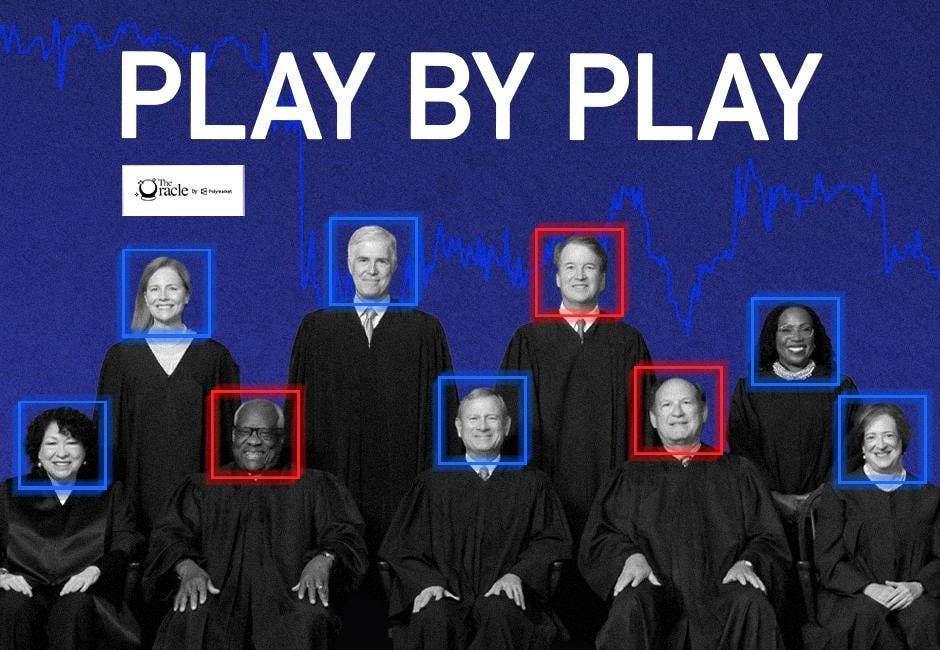
On Friday, Feb. 20, the Supreme Court ruled in a 6-3 decision to strike down Trump’s “Liberation Day” tariffs, provoking a furious response from the Commander-in-chief across every social media account he could get his hands on.
But, had Trump been watching Polymarket, he may have come to the same conclusion that traders reached over 3 months earlier: the tariffs were likely doomed in the high court.
Today, we revisit the November 5th Supreme Court oral arguments on the legality of the tariffs, a 4 hour period in which the odds for the court to uphold the tariffs was roughly cut in half: from 46.5% to 24%, a price the contract held with slight fluctuations until the decision was released on Friday.
Using a new open-source tool to synchronize Polymarket odds with video, it is possible to pinpoint the exact moments during the hearings that moved the market.

In the weeks leading up to oral arguments, conventional wisdom held that, due to the difficulty of “unscrambling the egg” of tariffs once they had been rolled out, it was a coin flip as to whether the Supreme Court allowed the tariffs to stand.
Traders agreed, with the price of the polymarket trading between 40 cents and 50 cents from early September to early November.
What moved the odds
On game day, here are the key moments that moved the odds (watch video)
Pregame (51% 📉 38%)
The morning of the hearing, odds fluctuated between 51% and 38%, eventually settling at the lower end of that bound as the hearing got underway.
A post that morning on ScotusBlog hinted that even Trump’s appointees were not sure to back him and floated the striking down of tariffs without refunds as a plausible scenario.
Sauer Opens Strong (38% 📈 41%)
The administration’s odds increased slightly following U.S. Solicitor General John Sauer’s opening arguments where he made the case for the executive branch’s broad authority in foreign affairs and ability to regulate foreign commerce conferred by Congress and regularly upheld by the judicial branch.
Gorsuch Strikes Back (37% 📉 27%)
Justice Gorsuch, who, along with Justice Roberts, was considered undecided going into the day, speaks for the first time, questioning Sauer for a 7 minute period that dropped the odds almost 10%. In his questioning, Gorsuch dismantled much of the solicitor general’s stance and forced him to walk back or qualify several of his key arguments.
Katyal’s Rebuttal ( 27% 📉 18%)
Neal Katyal, a lawyer for Companies against Tariffs, tackled tough questions from pro-tariff justices Alito and Kavanaugh, refuting Sauer and the administration’s case that Congressional precedent from 1977 justified their actions.
One key moment came when Katyal highlighted the government’s bragging that they had raised trillions through tariffs. This contradicted their claim that the tariffs were regulatory as opposed to revenue-raising.
War Powers Limits (25% 📉20%)
In the minutes following Katyal’s exchange with Alito the odds again rose to 25%, explained by Alito forcing Katyal to concede that the president has the power to impose things like quotas and embargos through hypothetical scenarios.
However, odds fell again when Justice Sotomayor and Katyal established that in previous emergency situations including wars overseen by Nixon and Bush, the usage of tariffs as a regulatory weapon required ratification from Congress.
Alito: Regulation, not Revenue (22% 📈 28%)
In dialogue with Oregon Solicitor General Benjamin Gutman, Justice Alito established that in times of emergency, which the administration considers this to be, broader powers to regulate foreign affairs should not be treated with increased suspicions of just being another source of revenue.
Point of No Return
In retrospect the turning point is clear:
The moment that Justice Neil Gorsuch, a first term Trump appointee, signaled fundamental skepticism of the administration’s legal theory in his first rounds of questioning, Polymarket traders saw the writing on the wall.
The price of the contract never again reached the level where Gorsuch began his questioning, and tumbled lower following Katyal’s rebuttal of Sauer and the administration’s case.
Watching Polymarket alongside the hearings provides a second-by-second aggregation of legal reasoning that provided a signal that was live and direct instead of having to be parsed from retrospectives from news sources.
The understanding that these tariffs were not likely to stand (which was also concluded in our interview of Peter Harrell directly after these oral arguments, where Peter also correctly predicted which way every justice would vote) could have provided valuable information to a multitude of small and large businesses operating in the US on a multi-trillion dollar question.
Introducing Polyvideo
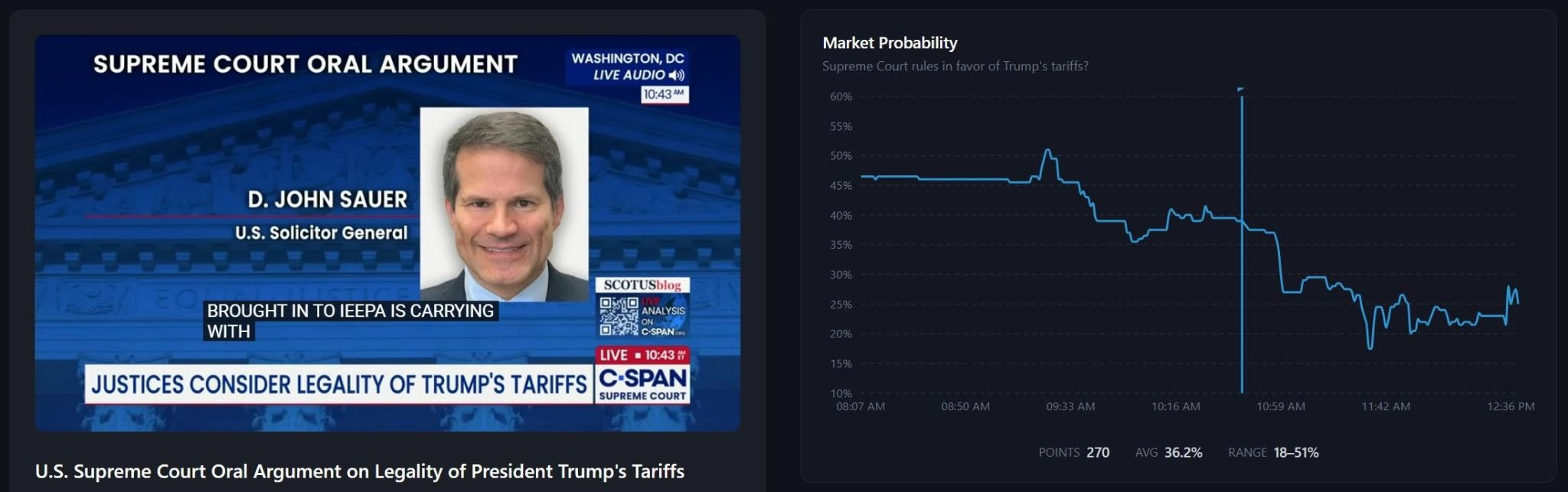
This analysis was conducted using a tool we developed called Polyvideo which allows users to view minute-by-minute odds of a polymarket side-by-side with a YouTube video.
The default settings on the front menu allow you to conduct the same analysis we did; feel free to use this for any future projects or contribute suggestions / features to the project in the comments or on X at @droovg.
Disclaimer
Nothing in The Oracle is financial, investment, legal or any other type of professional advice. All odds are time sensitive and subject to change. Anything provided in any newsletter is for informational purposes only and is not meant to be an endorsement of any type of activity or any particular market or product. Terms of Service on polymarket.com prohibit US persons and persons from certain other jurisdictions from using Polymarket to trade, although data and information is viewable globally.
I just spoke about Polymarket at literary event in London
Crazy