



The anonymous energy trader @CRUDEOIL231 on X manages a pod at a hedge fund owned by one of the world’s largest commodity trading firms.
He took a break from longing his oil longs to survey the damage to production capacity, and explain why leaving Iran in control of Hormuz is fundamentally untenable.

This interview has been edited for length. All answers are his own.
What do you make of the ceasefire deal announced yesterday? What will this do to oil prices in April / May / June?
Oil prices will likely show weakness for a few trading days. However, it is highly doubtful that this will lead to a permanent peace agreement.
Conditions such as Iran’s continued control over the Strait of Hormuz, acceptance of uranium enrichment, lifting of all major sanctions, payment of reparations to Iran, and a cessation of hostilities on all fronts including Hezbollah in Lebanon seem nearly impossible to reach a consensus on.
Iran’s control over the Strait of Hormuz directly conflicts with the vital interests of GCC countries, and the uranium enrichment issue remains difficult to resolve given the justifications for this war.
Lifting sanctions requires not just executive action but congressional approval. Furthermore, with both sides claiming victory, paying reparations would essentially mean admitting defeat and acknowledging acts of aggression. For the US government, this is an absolute non-starter.
The two-week ceasefire appears to be more of a tactical timeout rather than a fundamental resolution. While it may cap the ceiling for front-month prices, that’s about it. Oil prices will continue to stay at elevated levels.
Do you think Hormuz traffic will normalize? What time frame?

Iranian Foreign Minister Araghchi stated that safe passage through the Strait of Hormuz will be possible over the next two weeks, provided that “cooperation with the Iranian military and technical constraints are fully taken into account.” We need to consider exactly what this implies.
My thought is that this could mean bypassing the standard shipping lanes in favor of alternative routes toward Iran and Oman. Regardless, the flow will not return to normal.
The 150 million barrels of floating storage currently trapped in the Persian Gulf will likely attempt to exit the Strait. The short-term dip in oil prices reflects the market’s fear that this crude will hit the market all at once.
The real issue is the two-week timeframe. Since no one knows what happens after those 14 days, most shipowners might be willing to exit the Gulf from west to east to offload, but they will hesitate to enter the Gulf for loading.
Even in an optimistic scenario, I don’t see the traffic volume over the next two weeks recovering to more than 50% of pre-war levels.
What level of impairment has there been to Iran / GCC production capacity? If the ceasefire holds will production be able to snap back fairly quickly?
Nearly 12 mb/d of production has already been shut in, and it cannot be restored quickly.
First the tankers currently inside must exit the Strait. Then incoming tankers must enter from outside for loading. Finally to actually restart production, the onshore storage tanks, currently at full capacity, must be drained before the taps can be turned back on.
Therefore two weeks is nowhere near enough time to resume production. Even assuming the ceasefire holds, it would take at least 6-8 weeks to recover more than 70% of the shut-in volume. In the meantime, global crude inventories will continue to be drained.
You have written that any kind of deal that enshrines Iran as the tollbooth of Hormuz is untenable for Gulf states. Can you unpack this? Is it worse for some than others?

If Iran introduces a toll system, the GCC countries—especially Saudi—will never accept it. The flow through Hormuz is several times larger than the total spare capacity of OPEC+.
If Iran gains the ability to impose tolls, they will become the most powerful and unrivaled swing producer in history, controlling a global oil flow of approximately 20 mb/d.
This is an unacceptable situation for Saudi Arabia and the UAE. The issue isn’t the amount of the toll; it’s the fact that Iran would hold a say over the future flow of GCC countries.
They would gain the authority to arbitrarily regulate a 20 mb/d flow. Saudi’s influence doesn’t just come from being wealthy; it stems from their status as the world’s only true swing producer.
I don’t believe they can simply stand by and watch their regional hegemony handed over to Iran, along with all their leverage and influence.
For them, Iranian control of the Strait is a more existential threat than any missile or drone.
What do you make of the Iran hit on the Saudi petrochemical plants? What sources are you looking at here?
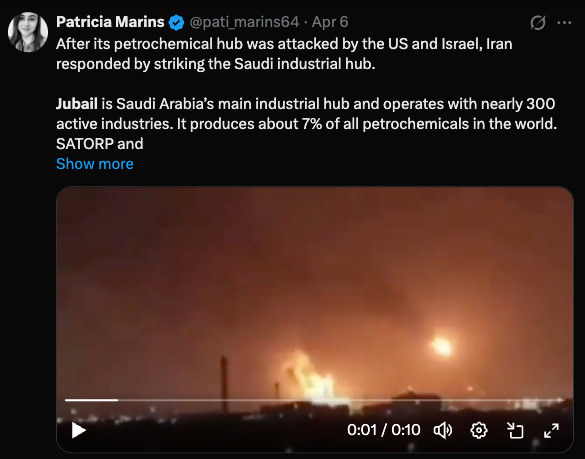
I believe this was a clear example of a proportional response. The goal was to demonstrate that if they strike our infrastructure, we can hit theirs back just as hard.
It wasn’t an attack aimed at mutual destruction. If Iran truly wanted to go for the nuclear option, the simplest and most effective way would be to target or contaminate the seawater intake systems of desalination plants across the GCC.
Striking petrochemical facilities was merely an act of retaliation. I monitored the flares via the NASA FIRMS system and directly confirmed the specific damage and its extent with a SABIC official.
How long would it take to develop viable pathways around Hormuz for the different GCC states?
Existing bypass routes like the East-West Pipeline and the Fujairah Pipeline are likely all there is. Saudi can reroute about 5 mb/d, and the UAE can divert around 1.5 to 2 mb/d of liquids.
Building new pipelines takes far too much time, and there is no guarantee that Iran—having already played the Hormuz card—would just sit back and watch such new bypasses being constructed.
Some ppl suggest using trucks, but that’s ridiculous. Just think about how many trucks it would take to move even a single million barrels. It’s simple math.
How do you think the ceasefire holds up or unwinds? What are the triggers or behaviors you’d be looking at for early signals?
As I mentioned above, the gap between the two sides revealed in this ceasefire announcement is much wider than it was before the war. Ultimately, a resumption of the conflict seems more likely.
We need to keep a close eye on the flow of US military assets into the Middle East and how much the actual traffic through the Strait of Hormuz recovers.
Furthermore the clashes between Hezbollah and Israel continue today. Since this is also part of the broader battlefield, it must be monitored closely. If these skirmishes persist, the window for diplomacy will only continue to shrink.
If you are a Gulf Arab state and think the current deal with Iran is unworkable, what levers do you have? Are they likely to try to stir up new rounds of conflict?

They are likely to try and drag the US into the war. They’ll be lobbying hard in Washington, and honestly, it won’t even require much finesse.
All they have to do is say: “Since Iran controls the Strait of Hormuz, we can’t restore our production even if we wanted to. We’ll be maintaining partial production cuts for the time being.”
If even a mere 2 mb/d production cut persists, oil prices will stay elevated, which will eventually force the US to seek a military solution. The US will find its way back to the Middle East on its own.
How are you tactically positioned on oil here given your views?

I have been rolling over front-month longs since the Brent April contract. I’ve booked significant profits, enough to fully cover my bonus pool for the next three years.
However today’s ceasefire announcement did lead to some losses in the June contract.
A supply shock is guaranteed due to the production already lost and the continued supply deficits we’ll see during the recovery process. Therefore once the market sell-off stabilizes, I plan to build long positions in back-month contracts.
Best accounts / sources to follow on the energy aspects of the conflict?
From a data perspective, sources like Kpler and Platts are essential. However I personally gained my most valuable insights through business trips prior to the outbreak, where I spoke directly with Saudi and Israeli officials.
In fact, I was in Tel Aviv when the war broke out, which gave me the conviction to bet big and realize significant gains.
I believe the opinions and intelligence from actors on the ground are what truly matter. That is exactly why I headed to the Middle East in late February.
Any new energy questions we should have on Polymarket?
It would be helpful to ask specific questions like: “Even after the ceasefire, will there be a physical attack on a tanker passing through the Strait of Hormuz within the month of April that disrupts traffic for more than 24 hours?”
Disclaimer
Nothing in The Oracle is financial, investment, legal or any other type of professional advice. Anything provided in any newsletter is for informational purposes only and is not meant to be an endorsement of any type of activity or any particular market or product. Terms of Service on polymarket.com prohibit US persons and persons from certain other jurisdictions from using Polymarket to trade, although data and information is viewable globally.
Definitely fragile ground as with anything to do with the Middle East.
This is the kind of setup where the headline says “pause,” but the system is still trading the same imbalance underneath. The trader’s framing is clean because it focuses on what can actually move, not what’s being announced. Flows, capacity, incentives.
If tankers are hesitant to re-enter, if production can’t restart quickly, and if control over the Strait is even partially discretionary, then you don’t have normalization. You have friction. And friction in a system this tight doesn’t disappear. It compounds.
The tollbooth point is the real fault line. It’s not about the fee itself, it’s about who gets to decide. Once that control shifts, every participant downstream has to adjust behavior around it. That’s where pricing power comes from, and it’s why this isn’t something the market can just fade after a few days of weakness.
The way I’d think about it is simple. Front-month relief can happen because positioning unwinds. But the back of the curve starts telling you what the system actually believes. If that stays bid, it’s not fear. It’s recognition that the constraint hasn’t gone anywhere.