

🔮 Doomberg: The Strait is Already Closed
The green chicken breaks down the energy implications of Iran's missile war, and where the next domino may drop


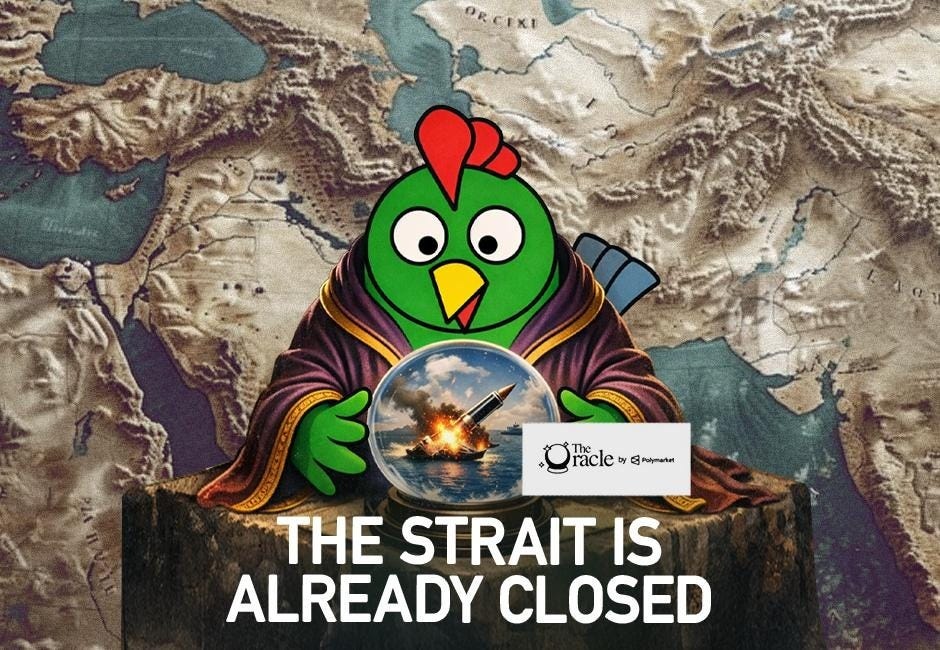
Doomberg is a pseudonymous team of former commodities executives publishing one of the top Substacks on energy, finance, and geopolitics under the iconic green chicken avatar.
The Oracle caught up with Doom on March 4, as the Iran-Israel war entered its fifth day, to discuss missile attrition, laser beams, what the Brent-WTI spread is telling us, and which Gulf Arab state he’s watching most closely.
This interview has been edited for length. All answers are Doomberg’s own.
The last time we spoke, we talked about your thesis that World War Three was a monetary struggle for the future of the US trading and energy system. Are we moving to the hot phase now?
In our view World War III started in 2014, when Putin sold his US Treasuries and placed the proceeds in gold. The war in Ukraine, which started in 2022, is the biggest hot battle before this one. And the Iran war is the latest battle in that same conflict. The economic trade war between China and the US is another battle. Iran is a BRICS state, a key supplier of crude to China, and an on-again, off-again ally of Russia.
There’s only really one battle left after this: US versus China over Taiwan. The world is in a very precarious place right now.
Your WWIII thesis suggests that Trump initiated this to knock out China’s energy suppliers, Venezuela and now Iran. But I’m hearing other arguments that Israel was dragging in the US. Where do you come down?
Look, Donald Trump’s the President of the United States. The buck stops with him. He’s the person that the US public has elected, and his party will stand for election in the 2026 midterms, and whoever wins the Republican nomination will be held to account and/or rewarded for whatever happens in the weeks ahead. Every country in the world is trying to influence the President of the United States for obvious reasons. Even if that’s true, it doesn’t matter to us.
One of the hallmarks of a lateral thinker is an ability to separate an emotional attachment to the correctness of an axiom from whether or not it is currently working to explain events. And I would argue that the energy axiom: that the US is in the middle of World War Three, and energy is at the core of all wars, and China gets its energy from Venezuela and Iran and Russia, and the US just happens to be in various stages of war with Russia, Venezuela, and Iran, I just find it very difficult or implausible to believe that this is all some Israeli-driven set of coincidences. And so yeah, we firmly are in that second camp.
What are the four or five most salient sources you’re looking at on a daily basis to understand what’s going on?
The primary things I’m looking at, because there’s just such a thicket of propaganda out there, are market indicators, things like Polymarket, but also the energy market. The energy markets are incredibly sophisticated. There’s billions of dollars on the line to getting these things right.
Over the weekend, I decided to try an experiment. I personally bought a new clean iPad and created some new login credentials and a fresh email and downloaded the Twitter app. And I spent an hour training the algorithm that I was pro-Iranian, anti-American. I wanted to see what that side of the world was telling itself. And two amazing things already a few days in: it’s a wholly different universe. Shockingly so. The standard Doomberg Twitter for-you feed versus that feed might as well be on different planets. The parallel universe theory of physics is alive and well on Twitter today.
Then yesterday, something significant happened and that feed was basically turned off. You can no longer find alternative views to what’s actually going on in Israel on Twitter in the way that you could in the first 48 to 72 hours after the war started. You actually have to live it to see it. With the snap of a finger, a switch was flipped.
Every single morsel of information Twitter is feeding you is being shaped, controlled, or influenced by somebody. That’s where I think markets do help. It costs money to manipulate markets, especially extremely liquid markets like oil and natural gas.
Beyond that, the only thing we’re really looking for now, three or four days into the war, is the answer to one simple question: Is Iran still firing advanced missiles and drones?
What about the missile laser system Israel apparently deployed on night one? Does that change the interceptor equation?
On the laser stuff, lasers are very energy intensive, and there’s only so much energy in Israel. They get it from natural gas. And those natural gas fields, if Iran is capable of launching missiles with targeting indefinitely, then it comes down to a missile defense war versus a missile offense war.
I saw Pete Hegseth out talking about essentially carpet bombing Iran. That’s not going to win the war. You could blow up as many homes as you want in Iran but you need to get these launchers. The US carpet-bombed Germany for how long in World War Two?
It’s going to be a lot of deaths, a lot of suffering. That’s not going to win the war. It’s going to make for great TV and convince people that the war is being won. But what really matters is: can Iran still launch advanced missiles and drones? Today is day five. They still can.
Let’s talk about the Gulf oil infrastructure. I’m surprised you’re focused on whether Iran can launch missiles at Israel rather than on what they might do to Gulf oil facilities and the Strait of Hormuz.
No, it’s wherever they decide to shoot them. They’ve made some decisions about where to shoot. They’ve kept some escalation in reserve. They may have effectively closed the strait, but they have not yet blown up Ras Laffan, for example, which is Qatar Energy’s export terminal. They lobbed a few drones that way to prove they can, and the company has preemptively shut it down and declared force majeure. But that infrastructure could be turned back on if the war ended tomorrow.
There’s a world where that restraint ends and Iran just blows up the Saudi oil fields, the export terminals, the oil pipelines, Qatar’s LNG export capacity. They’ve not yet done that. The missiles launched into the Arab countries, in many ways, is more important than what’s going on in Israel. Huge amount of censorship in those countries too. All eyes on Bahrain.
Ok, let’s get to the markets. Strait of Hormuz closure at 78% through March 31
As you’ve defined it, the strait is already effectively closed. I suppose we just need to get to the seven-day moving average. But there’s no value in betting it either way at 78% by March 31. I think that’s probably a fair price, because there’s a chance that the war resolves before then and the strait won’t have been closed by that seven-day moving average definition. And it does take seven days to get a seven-day moving average.
What about duration? How long does this go on?
Obviously everybody’s modeling this exact question. The thing we played around with yesterday is it’s not just oil and gas that go through that strait, but an awful lot of food and fertilizer too, and both ways.
How much food is actually in the Gulf Arab states allied with the US where the US currently has bases? How much food is in Bahrain? How much food is in Saudi Arabia? I mean, it’s quite literally the direct question. Nine meals to crazy isn’t just a prepper phrase.
We have not yet seen escalatory strikes on the desalination facilities across the Middle East. Those are milestones and markers we’d be looking for. That kind of tells us this war can’t go on for much longer. I don’t think the strait can be closed for two or three weeks.
We’re punching up a piece for this weekend on just what a precarious situation the European Union is in. Here we are again, five years after the beginning of the first energy crisis. Europe is coming out of the winter of 2025-26 with dangerously low gas inventories, still cutting off Russian imports, and the LNG markets are on fire. This can’t go on.
Iran’s strategy seems to be: launch targeted missiles and numerous drones every day, drip drip drip, and run the clock out on the global economic capacity to absorb this hit. Whether that’s successful or not is the only thing that remains to be seen.
Qatar Energy LNG resumes production by March 14. That was briefly above 90% this morning and crashed. What happened there?
That was the force majeure tweet from the official Qatar Energy account, which came out at 7:24am Eastern this morning. One wonders whether the announcement to suppliers went out earlier than the tweet, which would make sense.
Force majeure means: for reasons beyond our control, we are unable to satisfy our contractual obligations, and because this was outside of our control, we’re insulating ourselves from damage claims. Even if the war is resolved, it doesn’t necessarily mean production will resume right away. You have workers evacuating. It takes time to safely shut down these things and then safely bring them back online. That’s a pretty tight schedule for March 14.
Ceasefire by March 31 is only at 38%. Does that feel right?
If there’s only a 38% chance of a ceasefire by March 31, the world is going to be in a very different place. And if this war is still as hot on March 31 as it is today, oil and gas are mispriced.
The TACO trade is in the back of my mind too. The market might believe that Trump declares victory and goes home, like he did after the June 12-day war, obliterated Iran’s nuclear capabilities, declared victory. But we’re pretty far down that branch now, and his base is so split over the war. I don’t know how that happens. But the market is kind of indicating that’s at least one of the possibilities.
The other outcome is regime change, revolution, chaotic dissolution of Iranian society. One of those two outcomes would need to happen in the next couple of weeks, because I don’t think the strait can be closed for two or three weeks.
US ground troops / invasion of Iran, that’s been very spiky. Do you have a view on whether the US is serious about installing a government, or are they content to keep bombing with air power?
In reading the resolution rules, the market resolves yes if the US commences a military offensive intended to establish control over any portion of Iran. Now, there are portions of Iran that the Iranian government doesn’t really control, which is the Kurdish area in the West overlapping with Iraq and Turkey. And another way you could see significant US troops on the ground is along the banks of the strait, building a beachhead as a buffer zone to reopen the Strait of Hormuz specifically.
There’s also a history with the Kurds. If we were to insert boots on the ground, that would be a place to do it. “Any portion” is a very expansive definition. I’d say that contract at around 25% is being priced with a lot of time premium too, since it doesn’t expire until December 31.
Does Iran make China-Taiwan more likely? I’ve been surprised that this has been flat since this started.
In a world where Iran keeps firing missiles and the US runs out of interceptors, that would seem to be a pretty prime time for China to make a move on Taiwan. But China could also just embargo the island, cut off its hydrocarbons, and achieve its geopolitical objectives without a military clash. Is there a contract for “Will China try to embargo Taiwan before 2027”? Because that’s what I think they would do.
The two happiest people on the planet over this war are Vladimir Putin and Xi Jinping. Ukraine is not getting air defense missiles relative to what it could be getting, because there’s a whole bunch of them in the Middle East. There are reports, I don’t know if they’re true, that a THAAD system is being considered for movement from Korea into the Middle East. There were reports of THAAD-related assets being destroyed in Qatar yesterday.
China has been buying an extra million barrels a day of oil for a year. Russia has a lot of spare oil capacity. There’s an awful lot of oil sloshing around on the seas. And I saw reports that China is leaning on Iran to allow the strait to reopen — they desperately need that crude.
It would seem to open a narrow window of opportunity for China to make a move. If they don’t now, then when?
What are the energy markets telling us right now, and is it too early to play the Doomberg “sell the spike” normalization trade?
As we’re recording this, Brent is at $81 and LNG in Europe is at 16. Yesterday LNG in Europe was at 22 and Brent was kissing $85. That’s telling us the market is not anticipating $120 or $150 oil. The WTI-Brent spread is up from $5 to about $7.40, a 40% increase, but not a real crisis indicator yet. In a world where things really hit the fan, you could see that go to $10, $12, or $15. That would be our signal.
On the normalization trade: a little early. You don’t buy front-month puts — you buy year-out puts, because a year from now the price of oil is either going to be way lower than it is now, or it doesn’t matter because we’re all dead. This is kind of like Pascal’s Wager. Both oil and LNG in Europe are consolidating right now, telling us the market thinks there might be a path out of this war, even though we don’t see one. The market is probably right that this doesn’t go on indefinitely. The question is how much damage gets done before it stops.
Will other countries get involved? France is at 16% to strike Iran by March 31.
I think France will get involved. Macron has signaled he views this as an opportunity to reestablish French relevance on the geopolitical chess board. He’s sending an aircraft carrier there. He’s talking about spreading the nuclear shield of France around. But 16% for a strike on Iran specifically — that’s a question of definition. Involved versus strike Iran are different things.
Canada came out initially supportive then did a 180 yesterday. I was surprised.
This is something I’m really buying about Polymarket: the definition of resolution is really what you need. You can’t just look at the headline contract and say “that’s cheap.” You have to read the rules.
What polymarkets would you create now that don’t exist?
Regime change in Bahrain. I would load that one up right now. Bahrain is an 80% Shia majority Arab state. The US naval base has been badly damaged, wildly underreported in the West, and there are ongoing protests. The pro-Iranian strategic view is that achieving regime change in Bahrain would be the first domino to fall in the Arab states, which are largely ruled by unpopular monarchs. If we see regime change in Bahrain, that is a very important milestone that very few in the West even have on their radar or would understand the significance of.
Also: Houthi Bab-el-Mandeb closure. The Houthis have been less involved than one might have expected so far. The Iranian view is they’re holding back reserves for when air defense systems have been fully exhausted, so the impact of the Houthi offensive will be all the greater.
Disclaimer: Nothing in The Oracle is financial, investment, legal or any other type of professional advice. All odds are time sensitive and subject to change. Anything provided in any newsletter is for informational purposes only and is not meant to be an endorsement of any type of activity or any particular market or product. Terms of Service on polymarket.com prohibit US persons and persons from certain other jurisdictions from using Polymarket to trade, although data and information is viewable globally.
Doomberg is the best
I gave a polymarket talk in east london https://youtu.be/bWA-6jHZ88o