




Captain K and The Oracle go way back.
Before the 2024 election, we interviewed an analyst who was calling for Democratic outperformance despite the Polymarket forecast showing an insanely close race.
After that, I went looking to speak with a “data guy” on the right, someone who the Trump die-hards were reading to help them sleep easy at night.
One reader pointed me to Substack author Captain Seth Keshel.
Keshel’s work had been cited by Trump in his efforts to challenge the 2020 results and is a regular on the conservative podcast circuit. His forecast was aggressively bullish on Trump at a time when the conventional wisdom was calling it a coin flip.
In our first interview in October of ‘24, he told me, more or less, that he would bet his entire family’s net worth on a blowout Trump win, saying there was “literally nothing positive in the data for Harris at all, except for some polls.”
In the end, he nailed it.
Keshel was the only elections analyst I’m aware of to call Trump’s sweep of every swing state.
Today, we’re back for Round 2 with Captain K for an early look at his midterm map.
This interview has been edited for length. All answers are his own.
How is Trump doing with his base and with independents right now? Does the Epstein story move the needle for midterms?
The online discourse is disproportionate to reality on both. The base is divided, but when you look at voter registration data, the country is moving toward Republicans almost everywhere. Polling has never been great for Trump even when he’s popular. He’s at 45-46% approval sometimes, low 40s during the government shutdown, rarely over 50%.
But Ronald Reagan had a 63% approval rating in 1986 and Republicans still lost seats in the House. Any interpretation of how Trump is doing right now is going to be somewhat divorced from how midterms turn out.
On Epstein specifically, the messaging out of the administration set unrealistic expectations. But the midterms will be decided by six to eight percent of the electorate in a handful of states, and those people are thinking about rents and conditions around them, not about what’s happening on X.
A lot of Trump’s best accomplishments happened right off the bat. He shut the border down immediately, pardoned January 6 folks immediately. The things people are still waiting on are at the mercy of a very small Republican majority in Congress with Democrats locked in to block everything. That’s the real story.
What does Trump want to do that isn’t possible right now because of Congress?
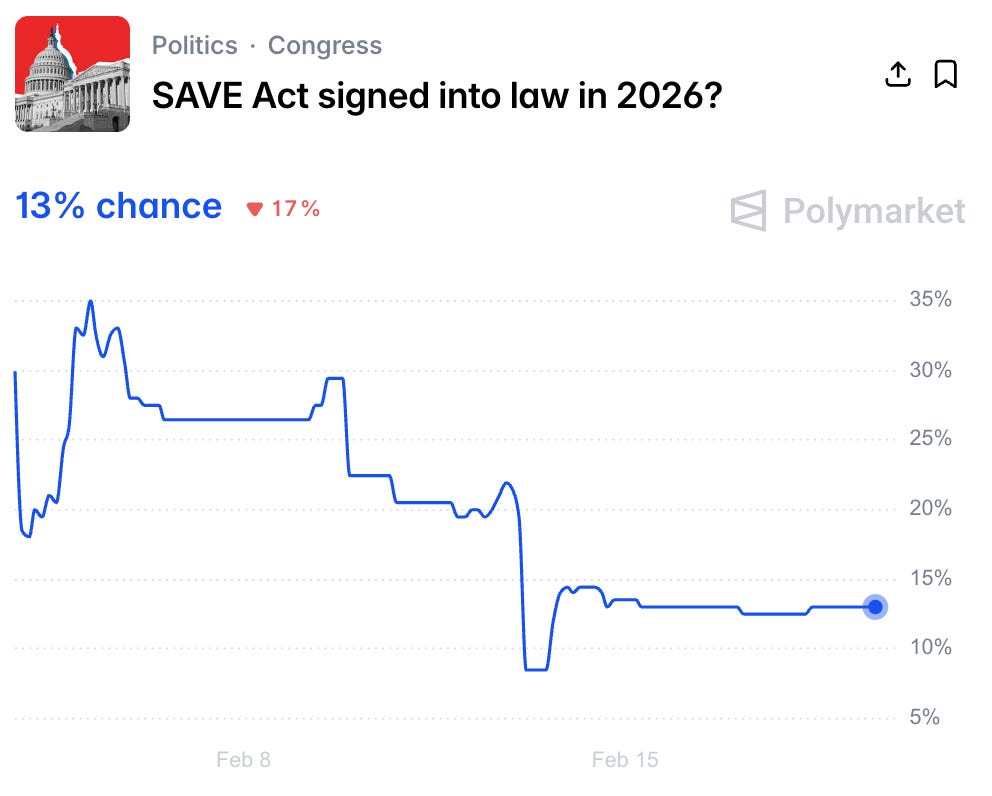
The SAVE Act is one. It passed the House and would require proof of citizenship to register to vote, plus voter ID provisions. The Senate doesn’t have 60 votes, so Thune is looking at ways to get it across the finish line with just 50, but even that’s iffy given Murkowski, Collins, and McConnell.
Any Supreme Court Justice nomination would also come down to a huge dog fight in the Senate.
What does the historical data say about midterms?
Since 1934, the president’s party has lost House seats in 20 out of 23 midterms. That’s 87% of the time, with an average loss of 27 seats.
The Senate is somewhat better, with losses in 16 of 23 midterms. The overwhelming historical evidence is that midterms seriously go against the president.
But you said you’re seeing Republican gains in voter registration almost everywhere since the 2024 election. How do those two things square?
I get this question all the time. Voter registration trends are extremely predictive for presidential elections because you get fuller turnout and more partisan behavior. In a midterm, you don’t have Trump on the ticket to drive base turnout, and the Republican majority is too small to absorb an average historical loss.
The registration data will eventually pay off in presidential years, and it takes states like Florida and Texas completely off the board for Democrats this cycle. But it’s not going to save Republicans in the key competitive seats that decide the House majority.
Walk us through your House map. What are you watching?

I consider 396 of 435 House seats to be safely predicted. That leaves 39 seats that will decide the majority. The states with the most competitive races in that 39 are California, New York, Pennsylvania, Michigan, Ohio, Arizona, Iowa, and Texas.

Of the 396 safe seats, I have it 200 Republican and 196 Democrat. When I add the leaners, I get Democrats up 209 to 207 with 19 true toss-ups I don’t have predictions for yet. My overall expectation is that whoever wins the House holds between 220 and 229 seats, so not a big majority either way.
Polymarket has Democrats winning the House at 83%. Is that too low given the history?
The historical average loss is 27 seats, which would hand Democrats the House easily. But Republicans have 200 safe seats they essentially can’t lose. They could lose every toss-up and still hold 200. So I’m at about 75-25 Democrat for the House.
Is there anything that could happen between now and the election that could seriously move your forecast? Wildcards to watch?
Two things. The biggest factor helping Democrats would be the Virginia Supreme Court upholding the new Democrat-drawn map, which would swing roughly plus-4 Dems, minus-4 GOP. That would be devastating for Republicans.
The biggest factor helping Republicans would be the Supreme Court striking down Section 2 of the Voting Rights Act, which would allow Southern states to redistrict and potentially pick up around 11 seats. But I also don’t know the appetite of some Republican-controlled states, like Georgia, to actually execute that redistricting. Indiana already dropped the ball on a similar opportunity.
People have been waiting on it. If it doesn’t happen in the next few weeks, it becomes a non-factor for 2026. But it will absolutely crush Democrats in 2028 for the House if it comes down then.
Polymarket has “Blue Wave” (Dems win House plus 49 Senate seats) at around 70%. What’s your number?
I would put the odds of a Blue Wave, as you’ve defined it, at about 25%. I think Democrats are likely to win the House, so if you define Blue Wave as just that, bet heavily in favor. But I don’t think they get to 49 Senate seats.
That means knocking out Susan Collins, and they never get Susan Collins. I would put Blue Tsunami, which I’m guessing you define as 235-plus House seats and 51 Senate seats, at 5% or less.
Where are Republicans most vulnerable in the Senate?
North Carolina is the most vulnerable GOP seat. Tom Tillis has won twice but never by more than two points. The Democrats have Roy Cooper, a former two-term governor with major name recognition, almost certainly as their nominee. Republicans will likely run Michael Watley, who’s Trump-endorsed but not well-liked by the grassroots.
Maine is the second most vulnerable. Collins votes with Trump about 94% of the time but is 50-50 on the most important votes. She survives because she outperforms Trump by huge margins in Southern Maine, which is basically suburban Boston. Her opponent is likely either Janet Mills, the current governor, or Graham Platner, a Bernie-aligned progressive with some controversy around past comments. If it’s Platner, Collins wins easily. Mills is tougher, but I still lean Collins. People should look up Sarah Gideon in 2020, who had everything going for her and still got smoked.
What about the two vulnerable Democrat seats?
Michigan and Georgia. Michigan is an open seat, and notably Gretchen Whitmer is not running for it, which is basically an announcement that she’s running for president in 2028. I actually think Whitmer is the strongest Democrat on paper for 2028, and almost nobody’s pricing that in. The Republican Mike Rogers has a shot because the Democrat field is weak. I’d call Michigan 60-40 Democrat.
Georgia is John Ossoff defending a Trump-won state. He’s mostly harmless as a candidate, plays well with college-educated Atlanta voters, and benefits from the fact that the Trump base doesn’t turn out in big numbers in midterms, as we saw with Herschel Walker in 2022. I’d call Georgia 65-35 Democrat.
Where are you focused on the governor races?

The most important governor’s race in the country, from a conservative movement standpoint, is Arizona. Getting rid of Katie Hobbs is critical because there is election reform legislation ready to go, similar to what Florida did, that Hobbs won’t sign. Republican voter registration advantage in Arizona is almost exactly twice what it was in 2022 when Hobbs won her own election by 17,000 votes.
I think Andy Biggs wins the primary easily and then wins the general. He plays well with the soft moderate Republican voters in Maricopa County, who tend to be heavily Mormon and are usually the ones who wander off when the race tightens. I’d put Biggs as the nominee at 80-85% and favorite in the general.
Georgia has an open seat and it’s a mess. You’ve got Keisha Lance Bottoms likely for the Democrats and a bunch of establishment Republicans like Brad Raffensperger and Chris Carr who don’t excite the base. I give Republicans a 55-45 edge to hold that governorship.
Wisconsin I lean Democrat 60-40. Michigan I think actually has a Republican shot because there’s a left-wing independent candidate in the race who will split the Democrat vote. John James would be the GOP nominee and he’s a strong candidate, Apache pilot, young, sitting congressman. It’s competitive.
Minnesota is the wild card people keep asking me about because of Lindell. But now that Klobuchar is running, I don’t see a path. She wins by massive margins every time. If Lindell wants to win, he has to run as Jesse Ventura, all crime and populism, not as a conservative culture warrior. But there’s no guarantee he even gets the nomination since Minnesota has a party nominating convention, not a primary.
We have Alaska Senate at almost exactly 50-50. You think it should be 25% for Peltola?
Yes. Mary Peltola is a great candidate and she has the ranked choice dynamic working in her favor, same as in 2022. But Alaska strongly prefers federal Republicans. The current senator, Sullivan, got 54% of the vote in 2020, about the same margin Trump ran.
He’s an incumbent, Trump’s energy agenda is popular in Alaska, and there will be fear about a Democrat obstructing those policies. I’d put Peltola’s chances at about 25%.
Ohio Senate is at 57% Republican. Too low?
I’d say 85% Republican. Ohio is not a purple state anymore. It’s on the path Iowa took, becoming a solidly Republican state. Democrats are also going to be spending money playing defense on three House seats that got redrawn, which means less resources for the Senate race.
Any big foreign policy event that could change the midterm calculus?

I don’t think an Iran strike would help. The younger base of the Republican Party really doesn’t want Middle East involvement, even under good cause banners. There’s significant PTSD about that in the GOP base. Trump’s instincts are to avoid prolonged ground wars, that was one of his clearest campaign positions, but not everyone around him has the same mindset.
What’s the biggest midterm mispricing you see on Polymarket right now?
The Blue Tsunami market. Thirty-four percent is still too high. Give me under 5%. The Senate map alone makes it basically impossible. Democrats have to hold Georgia and Michigan and flip both North Carolina and Maine to even get to 49 seats, and they have to do all of that in a year when they’re likely to win the House by running up the score in safe seats rather than breaking through in red territory. It’s a bad map. The House will be close and the Dems will probably take it. The Senate is a coin flip at best.
Follow Seth Keshel on Substack and X. His book, The American War on Election Corruption, is available March 5.
Disclaimer: Nothing in The Oracle is financial, investment, legal or any other type of professional advice. All odds are time sensitive and subject to change. Anything provided in any newsletter is for informational purposes only and is not meant to be an endorsement of any type of activity or any particular market or product. Terms of Service on polymarket.com prohibit US persons and persons from certain other jurisdictions from using Polymarket to trade, although data and information is viewable globally
Sorry AB the proof is coming out about the election in 2020. Georgia has admitted it!
You’re asking this guy for election predictions but completely elide the fact that he says the 2020 election was stolen? He is completely wrong about a giant election issue. Seems relevant