




In June 2024, Polymarket launched markets on how many times Elon Musk would post to X in a given week.
Elon tweet futures have since become a micro asset class, growing from $136k to $46.5m of volume in the last week of February 2026 - a 342X increase.
Watching the markets trade over several weeks, I began to obsess over a question:
Is there any edge here?
Or was this just a random walk through the mind farts of a dopamine addled billionaire?
Could I model Elon’s tweets?
After pulling all 86 weeks of historical market data and coding a tool: elonXforecast.com, the answer surprised me:
Elon’s tweeting habits are quite predictable.
I identified three key factors that give a tradable edge in these markets: momentum, weekly pacing, and outlier news events.
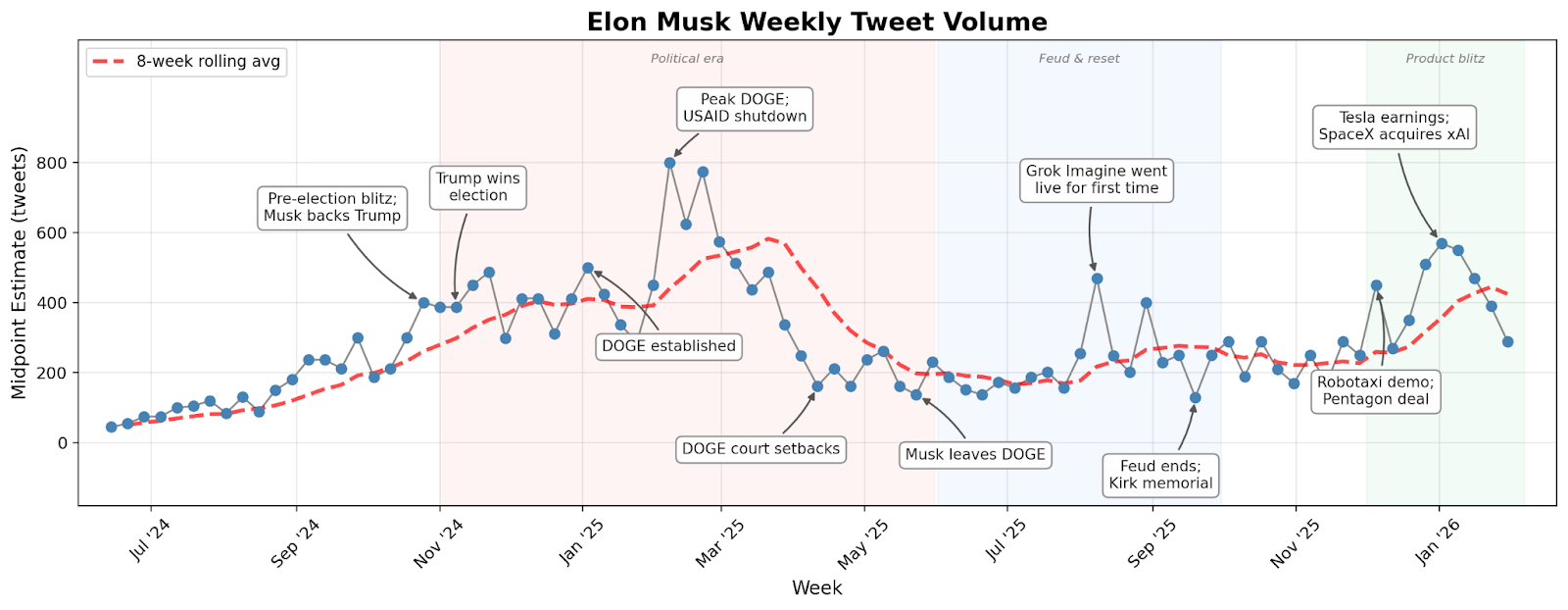
Looking back at the data gives a window into Elon’s recent arc. We see a steady uptrend through the 2024 election, a blowoff top in the DOGE era, and a second surge in late 2025 as Musk pivoted back to Tesla, xAI and SpaceX.
But enough about the past.
Let’s predict the future:
Factor 1: Momentum
It should be clear from the chart above that Elon’s tweet frequency does not make huge jumps from week to week: it exhibits momentum.
To quantify this we use a transition matrix.
Think of this as a cheat sheet: you look at how much Elon has tweeted this week (Low, Medium or High) and it tells you the probability of next week’s count based on past trends.
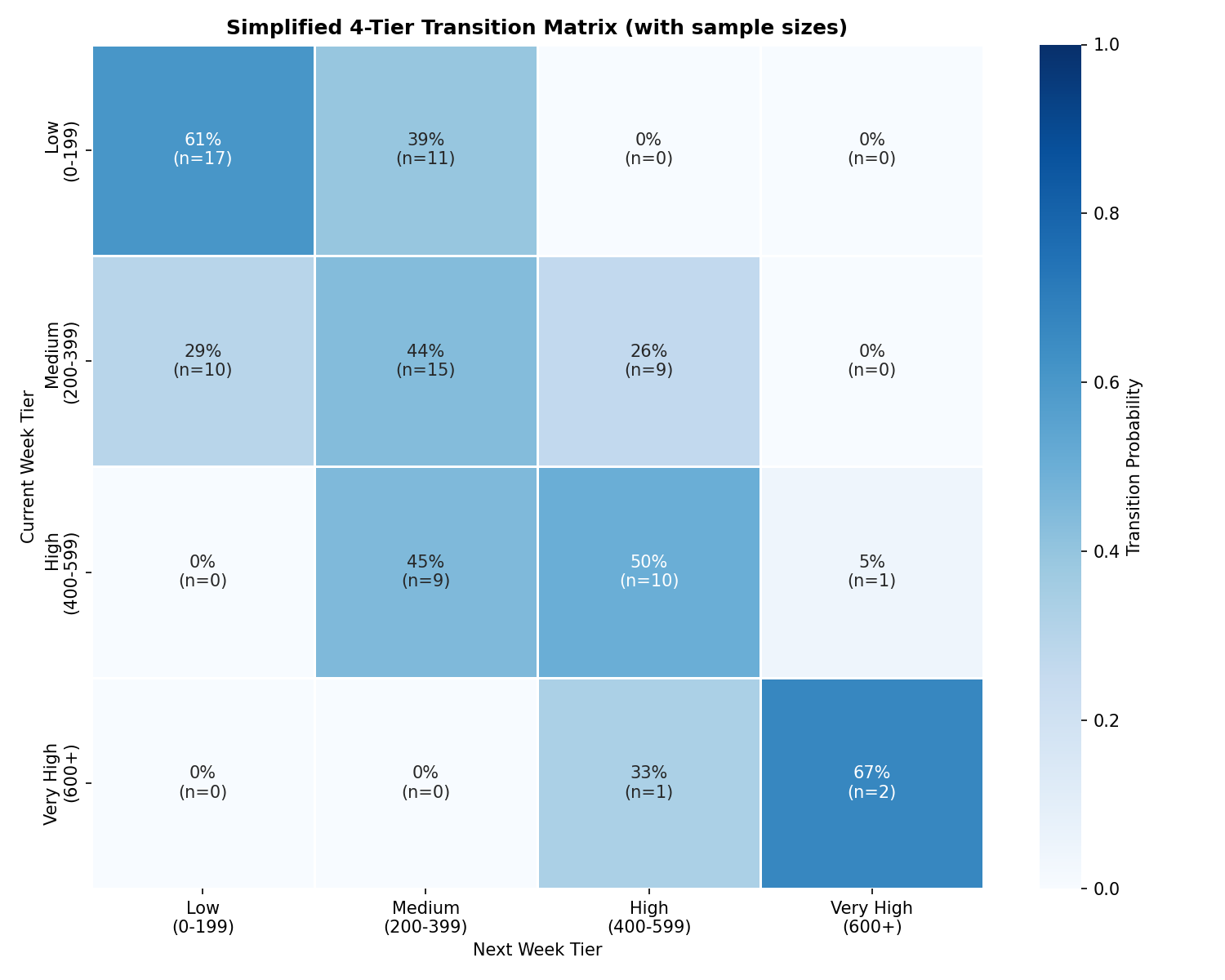
In the chart above, we see that a “Low” week (0 - 199 tweets) has a 61% probability of being followed by another “Low” week. A 39% chance of stepping up to “Medium” (200 - 399), and negligible odds of leaping to “High” or “Very High.”
Knowing that this week is likely to resemble the last, traders can check the prior week’s tier to have an idea of where the week will land, fading extreme buckets if the odds don’t support them.
It’s important to note that the sample size is very small on “Very High” (600+) weeks, with only 3 observations. The data is more robust in the low and medium tiers, where most weekly counts fall.
For “High” (400 - 599) and “Very High” weeks, the key takeaway is directional: volume tends to remain elevated once reached.
Factor 2: Mid-Week Pacing
The second tool we have for predicting tweet volume is the pacing curve.
By monitoring how many tweets have accumulated so far, we get a sense-check on whether the week is running hot, cold, or on pace.
This lets you project forward with confidence and spot when Polymarket prices lag behind the real data.
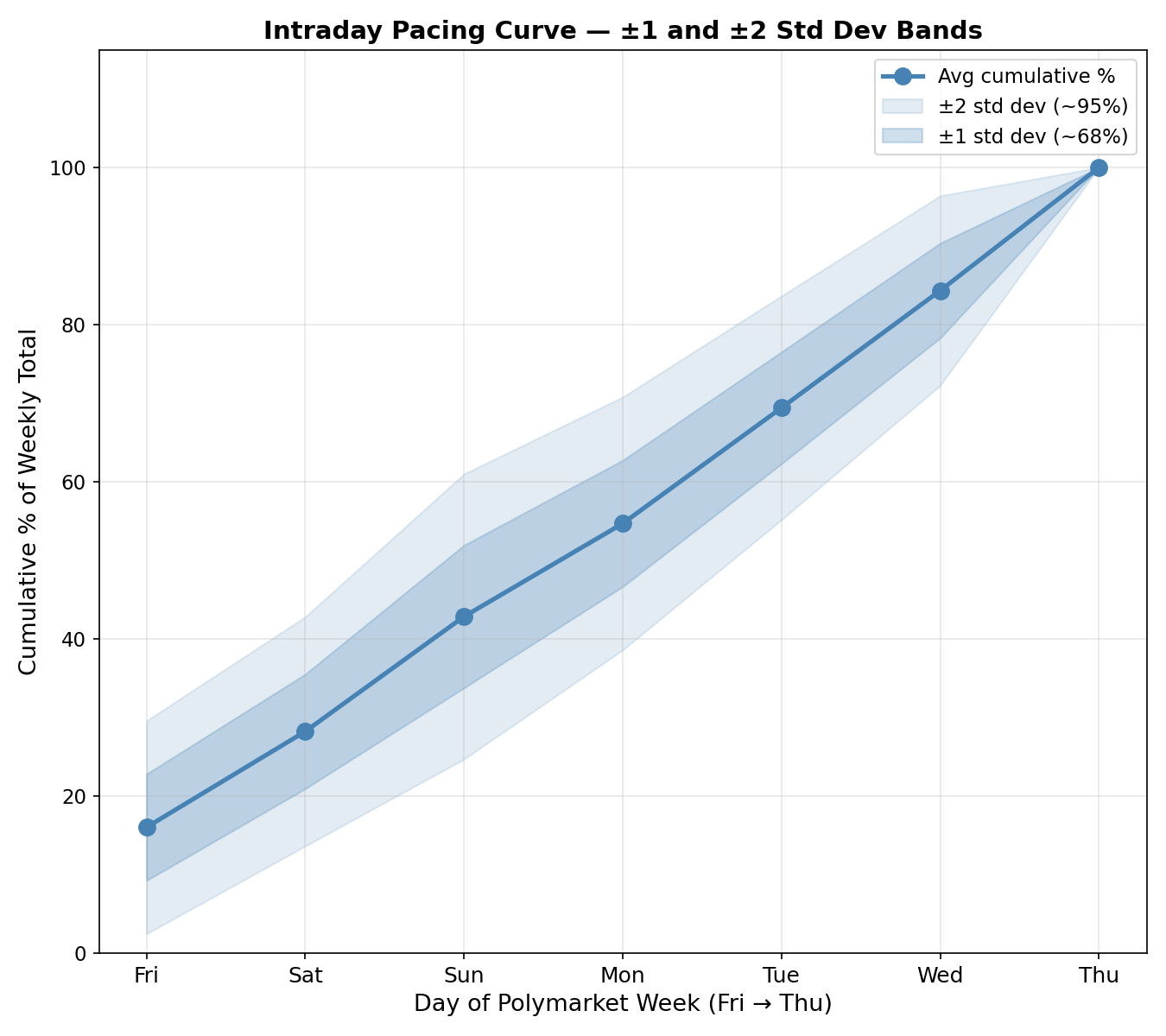
The diagram above shows the share of a typical week’s total tweets posted by day of the week over the last 14 weeks. What we see:
Earlier in the week, when uncertainty is high (larger shaded blue area) the band is wide and projections are loose.
By Tuesday, ~69% of the weekly total has usually been tweeted, narrowing the range significantly. If Tuesday’s count is 280 tweets and pacing shows 69% complete, the implied full-week total is 280 ÷ 0.69 ≈ 406 tweets. By cross-checking Polymarket odds, you can determine if it is within this probabilistic range or not.
The pacing curve is best used with the transition matrix: use the prior week’s tier as the starting expectation, then update it live with pacing curve data. If Tuesday’s pacing runs 20% above the average, the week is drifting towards the upper end of the matrix range and we may be heading for a breakout.
Factor 3: The Woke Mind Virus

The first two factors are all about continuity.
But the life of Elon over the last two years has been anything but smooth: rocket explosions, political explosions, outbreaks of the ‘woke mind virus’ – these are all factors that can cause large moves in the tweet count.
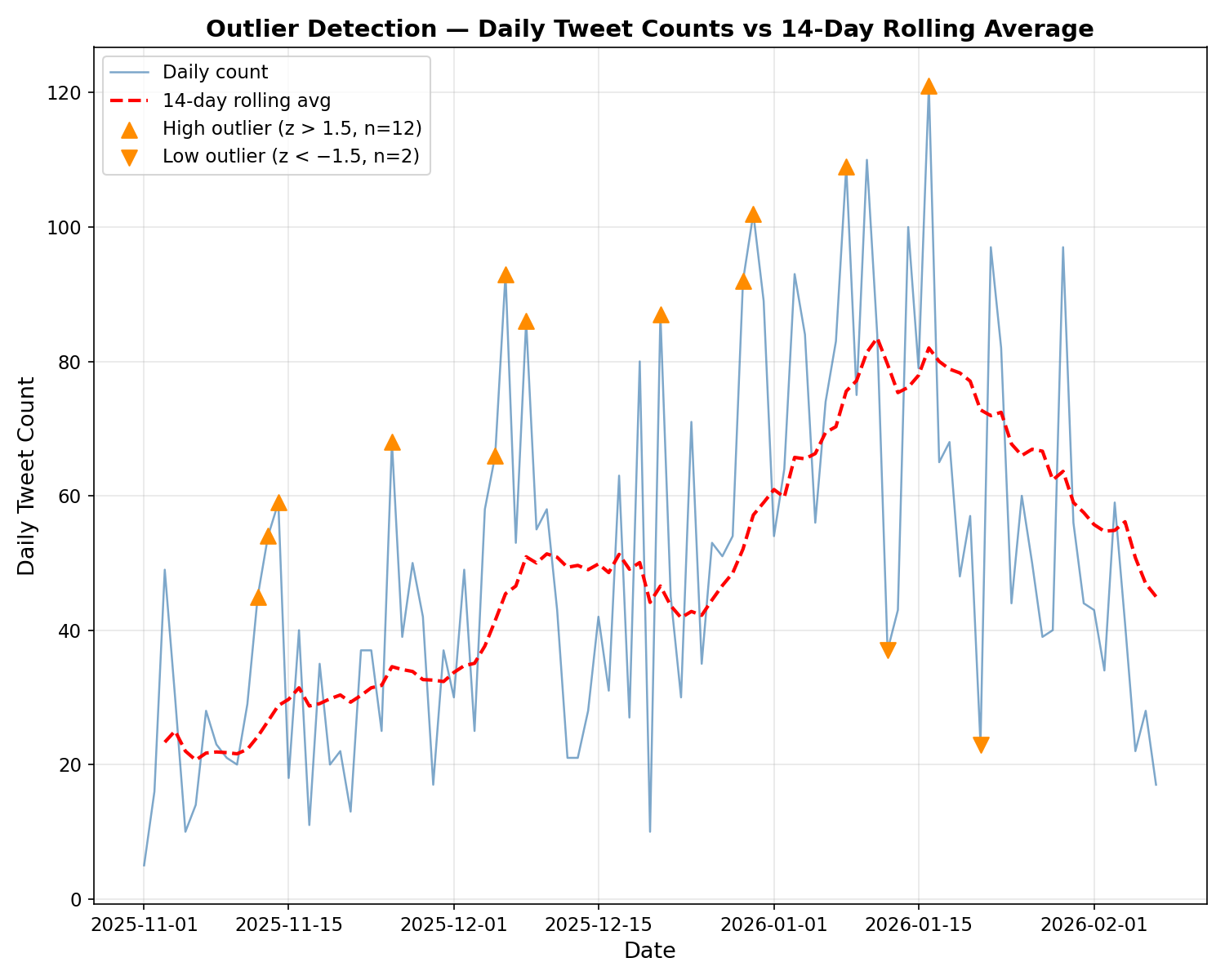
The diagram above plots actual daily tweets against a moving average of the prior 14 days, highlighting periods where volume strays from recent norms.
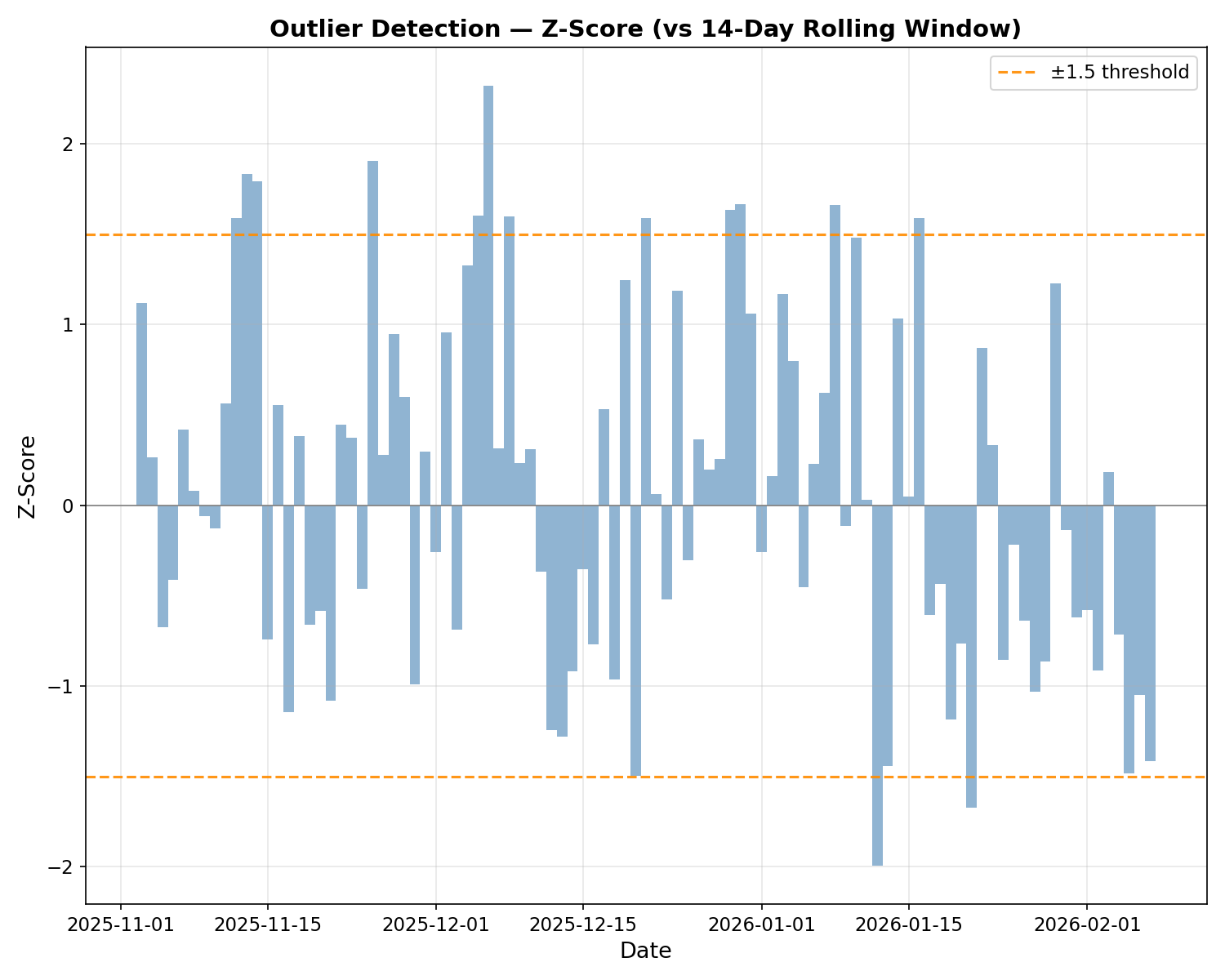
The z-score tells us how far off today’s count is from the rolling 14-day average. A positive z-score indicates above-average spikes, while a negative one signals below-average dips.
I used a 14-day window to compute the rolling average. This is because the base rate of Elon’s tweets moves with events. This adaptive approach ensures outliers are flagged relative to the current “normal,” capturing surprises as trends shift. The below table shows the types of events that can cause outliers in the data:
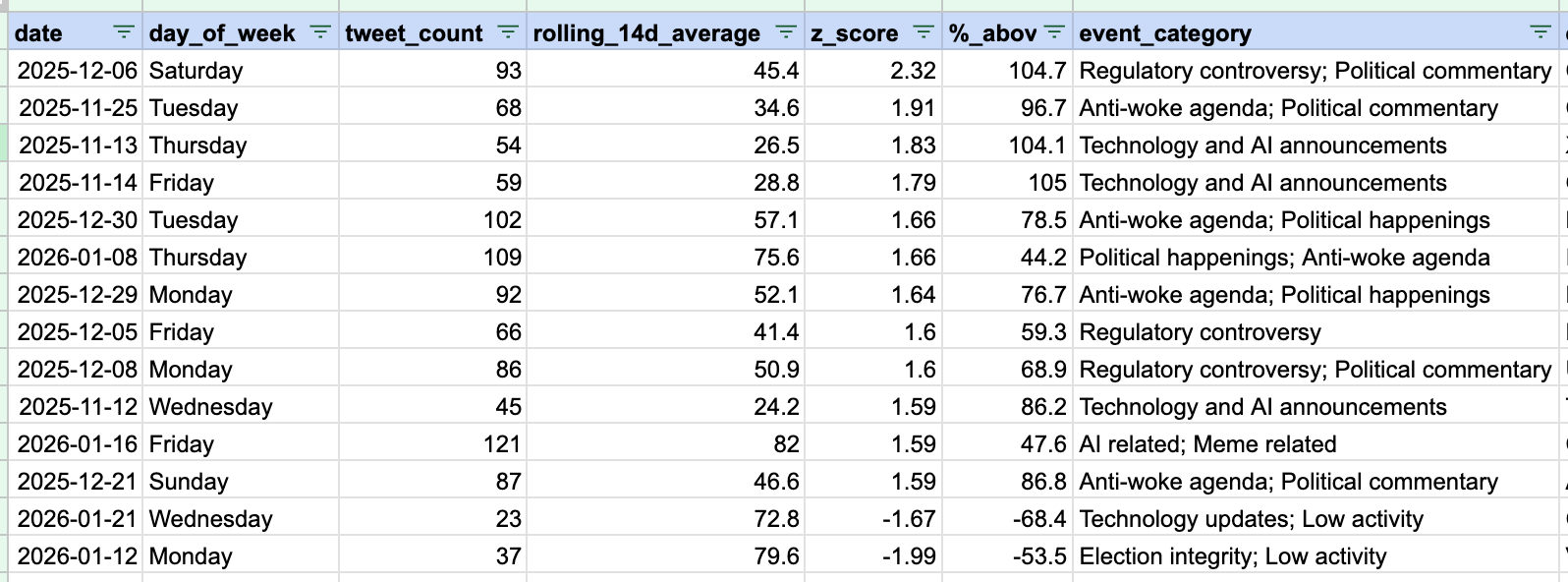
Most of these departures, 85% to be exact, are positive outliers (volume spikes). Looking at the categories, we see some trends:
“Woke Mind Virus” and other political commentaries tend to spark extended threads that can balloon the weekly total.
Tech updates and election integrity topics are normally associated with lower tweet levels.
Is Alpha Available?
The above factors are all about what drives the final number of tweets each week.
But it doesn’t answer the big question: can I make money on this?
Are there consistent mispricings in the odds that tweet quants can capture?
The answer, happily, is Yes!
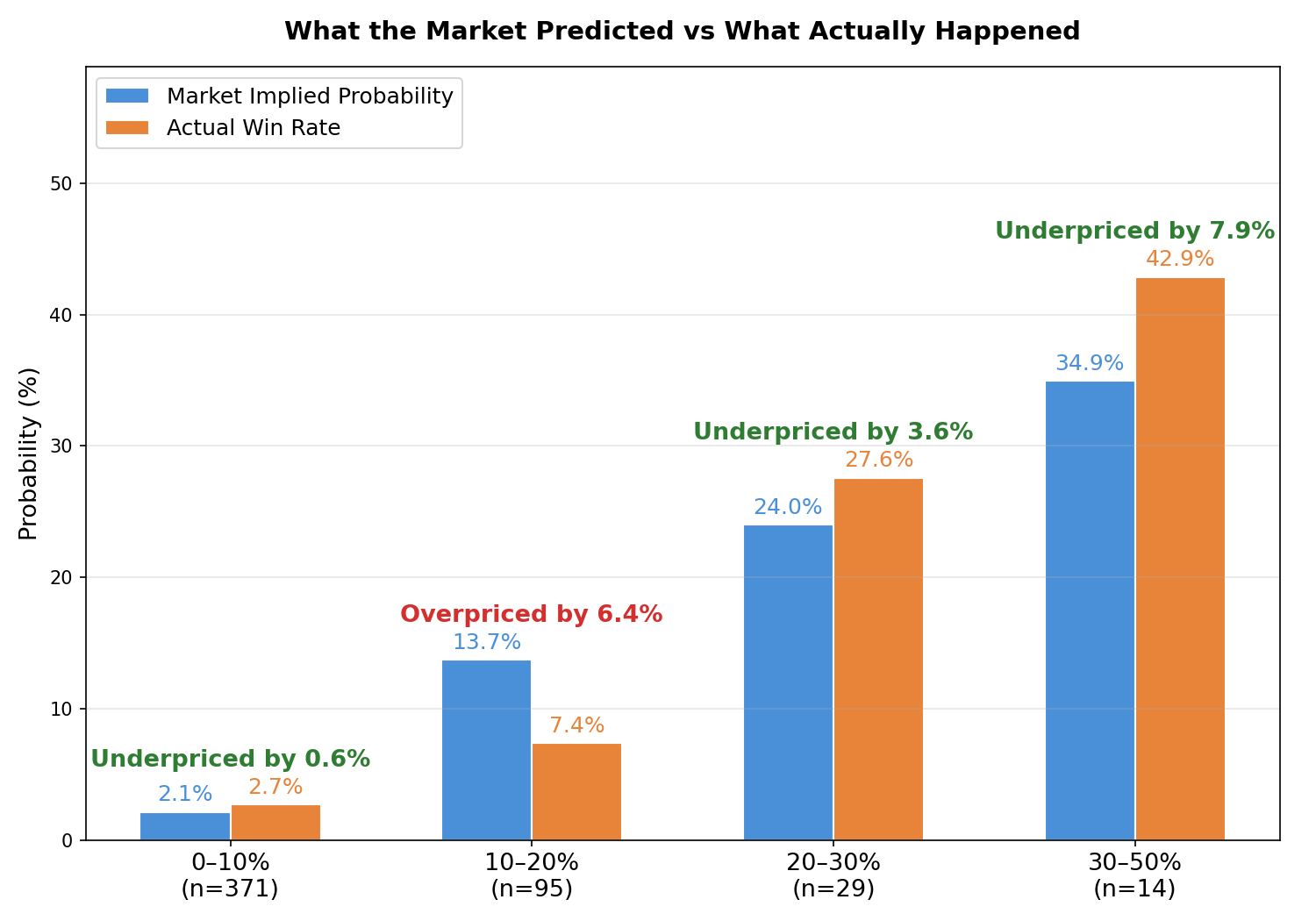
A look at the markets’ history shows that traders tend to overvalue longshots (low-probability outcomes) and undervalue favorites (high-probability outcomes).
In the diagram above, buckets in the 10-20% range have an actual win-rate of 7.4% despite being priced at 13.7%. Meanwhile, the buckets priced from 30-50% win ~43% of the time, more often than the implied odds of 34.9%.
This situation is well documented by Snowberg and Wolfers, who found out there is a tendency for markets to overprice longshot outcomes and underprice favorites. This is driven by how our brains process probability, rather than lack of information, a dynamic that persists even as volume scales up.
We can distill the insights into 2 actions:
Buy NO shares on the 10-20% buckets at the start of week; or
Buying YES shares on the 30-50% bucket.
However, the two strategies have very different risk profiles. The case study below shows why:
Case Study: August 8, 2025. The Market Flip
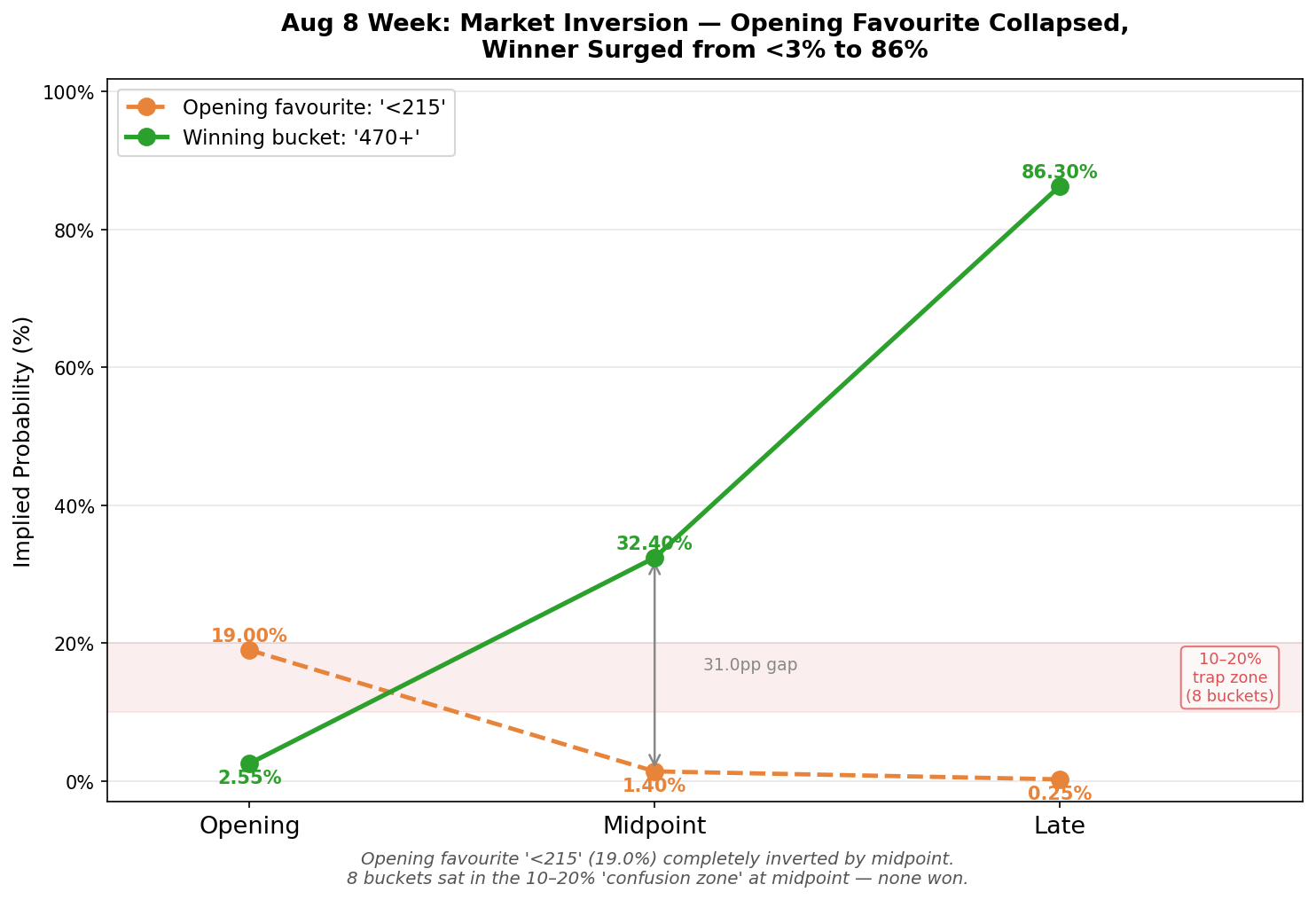
It’s August 1st.
The market opens expecting a quiet week where “<215” is the favorite at 19%. The eventual winner, “470+” sits at 2.55 cents. Nobody is prepared for what is coming.
Then Grok Imagine launches and Elon blitzes the timeline with posts, adding more fuel to the raging Trump-Musk feud. By midweek, the tweet count blew past 200 and the market scrambled to reprice the upper bracket tweets.

A trader buying NO on every 10-20% bucket at the start of each week across 35 weeks would have placed 97 trades, won 90 of them (a 92.8% win rate).
Putting it into Practice
Combining these gives us a three step workflow:
Before the week begins, check the transition matrix to narrow which tiers are realistic. Buy the NOs where YES is at the range of 10-20%.
As the week unfolds, track the pacing curve, by midweek, 69% of weekly volume is typically posted, enough to project a final total and compare that against Polymarket prices.
If pacing diverges sharply from what the matrix predicted, check Elon’s feed for outlier trigger topics before sizing up or down. The idea is that you are buying NO shares on the ones that are systematically overpriced.
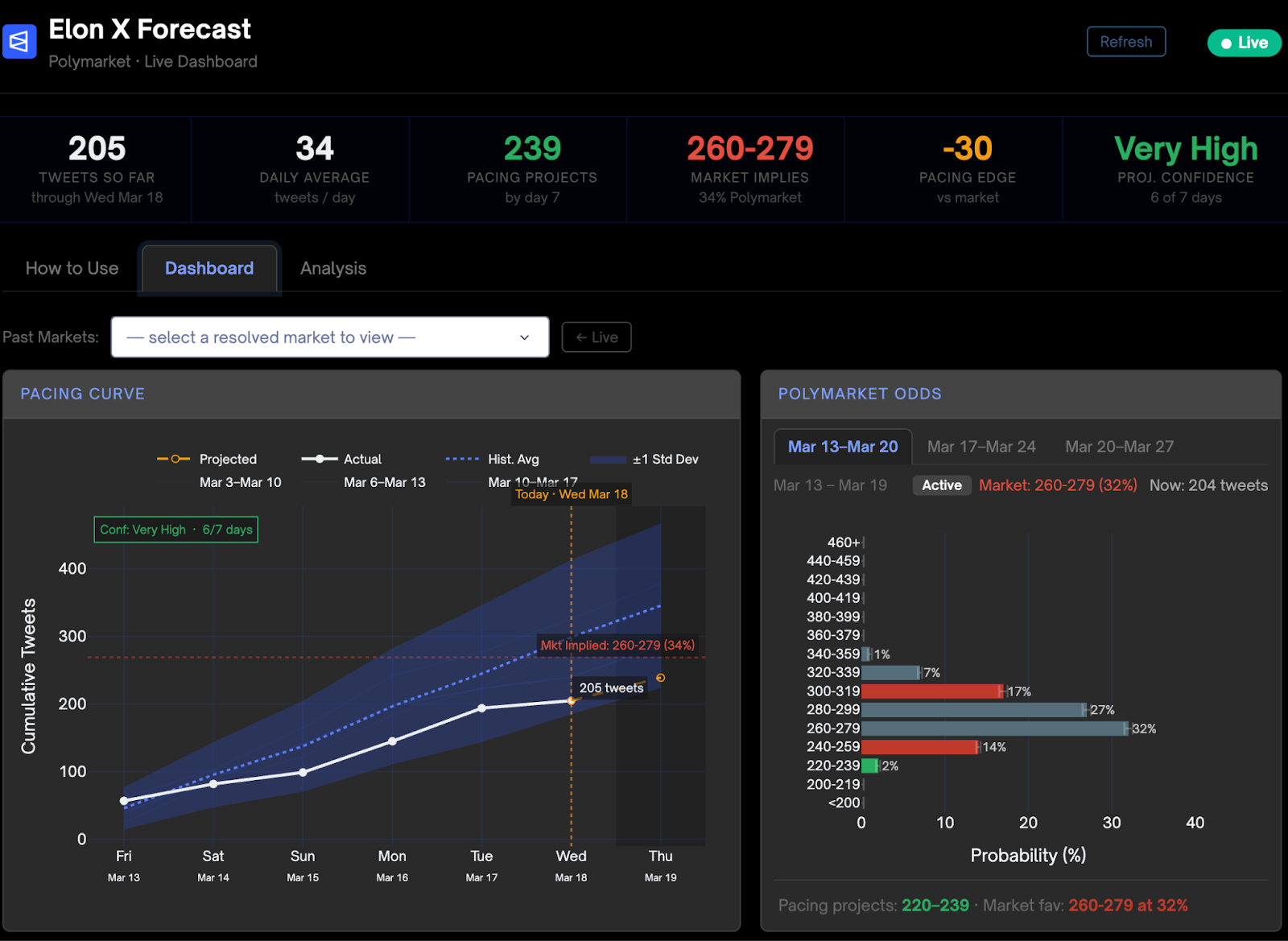
To make this easier, I’ve released the tool I created for this article:
It combines a live pacing curve with the Polymarket data from the current weekly tweet markets, giving you a real time dashboard for Elon tweet trades.
The good news is that, while these markets have grown massively in volume since launch, they are still not quite an institutional grade asset class so there’s likely a bit more time before the Jane Street guys show up.
Even still, 50 years of evidence suggests even they can’t fully arb away the longshot bias that has been a constant feature of even deeply liquid prediction markets.
Follow Terry on X.
Disclaimer
Nothing in The Oracle is financial, investment, legal or any other type of professional advice. All odds are time sensitive and subject to change. Anything provided in any newsletter is for informational purposes only and is not meant to be an endorsement of any type of activity or any particular market or product. Terms of Service on polymarket.com prohibit US persons and persons from certain other jurisdictions from using Polymarket to trade, although data and information is viewable globally