




Werner K Zagrebbi is a board-certified Superforecaster™ who writes about politics and economics at Right Rationalism.
Nina Totenberg is NPR’s legal affairs correspondent. At 82, her resume includes breaking Anita Hill’s harassment allegations against Clarence Thomas, reporting on secret Court deliberations during Watergate, and exposing that Douglas Ginsburg had smoked marijuana, which ended his chances at nomination.
And so at 10:51 AM ET on Tuesday, June 30th, when National Public Radio published a story headlined “Justice Samuel Alito Retires”, the markets took her seriously. The polymarket on Alito announcing his retirement by December 31, 2026 was trading at 37.5%. Nine minutes later it had shot up to 88%.
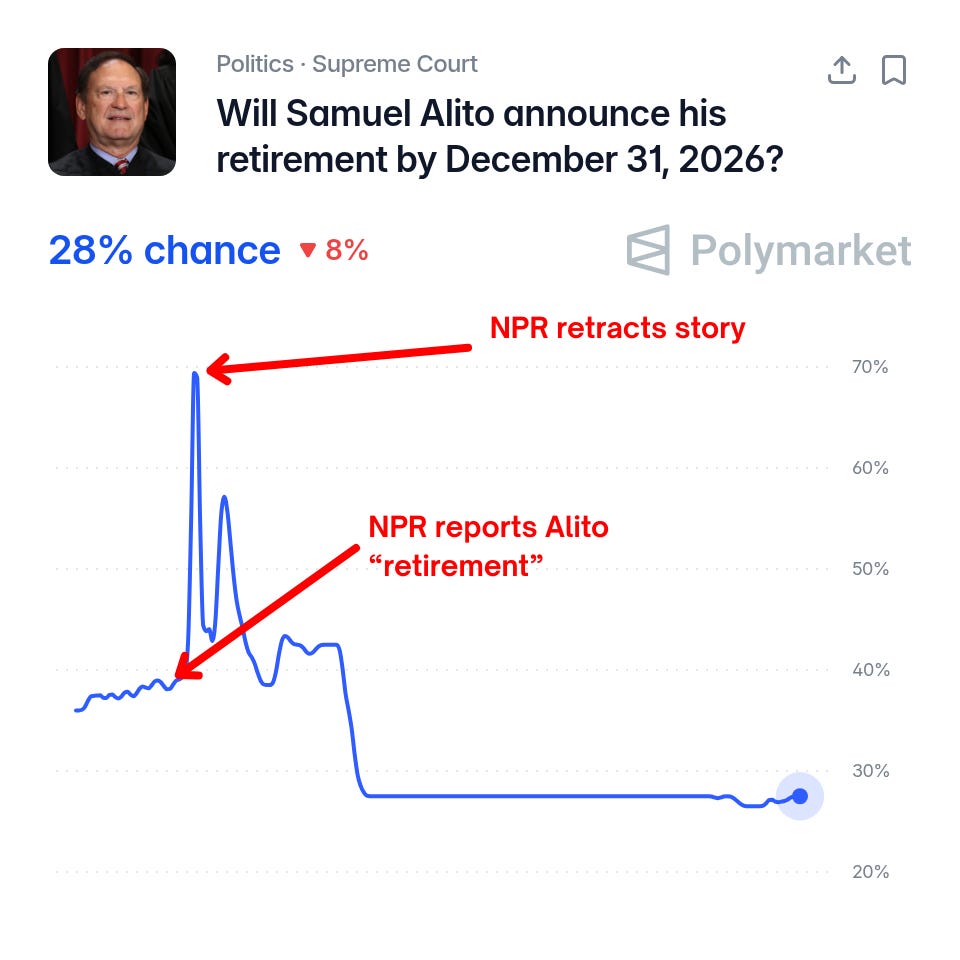
Sixteen minutes after publication, however, NPR retracted the story. By evening, $552,265 of trading volume later, the contract had settled at 29%.
Did the market behave well?

Domer (aka ImJustKen), one of Polymarket’s most followed sharps, certainly handled it well. His wallet sold 11,314 shares of YES at $0.902 at 11:04 AM, four minutes after the peak and three minutes before NPR pulled the story. He then bought 18,690 shares of NO at $0.579 twenty-five minutes later—for a profit of ~$10k.
Two things had to happen in the four minutes between NPR’s publication and Domer’s sell. First, someone had to look at the article and notice it was structurally broken. Second, someone had to check the actual resolution source, which is the Court itself.
Both were public in real time. On Bluesky, six minutes after publication, the legal commentator David Lat asked whether SCOTUSblog had received a release from the Court’s Public Information Office. Mark Walsh, physically in the Court press room, answered that it had not. That thread was live at 10:57 AM. Ken sold at 11:04 AM.
Leak Bait?
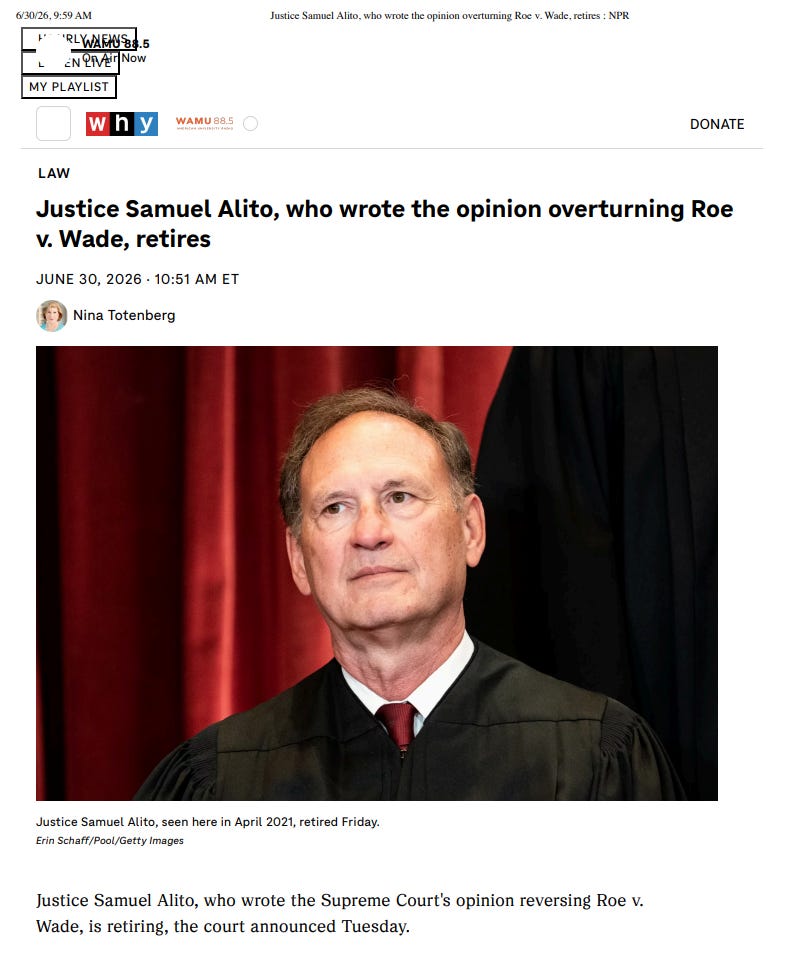
A careful reader of the Totenberg article contained more warning signs. Take a look—the caption to the leading photo says that Alito “retired Friday,” while the first paragraph claims his retirement was “announced Tuesday” (which—at the time of publication—was today).
It’s grammatically possible that NPR meant “Alito had already retired Friday, and the Court announced it Tuesday,” but given the context it’s implausible.1
The article also quotes a Yale Law professor as saying that Alito “will forever be remembered” as the justice who “took sown Roe v. Wade” instead of “took down”—which is not the kind of copyedit that usually makes it through NPR.2
Many have argued that this story was an “embargo breach” or that Alito planted the story to catch a leaker. I think it’s worth taking off the tinfoil hat on this: A real embargoed story would probably not have an egregious contradiction between the lede and leading photo’s caption. If NPR had been given advance notice by the Court or some political insider, the basic timeline would not read like it had been assembled from three incompatible drafts.3
“Rookie Mistake”
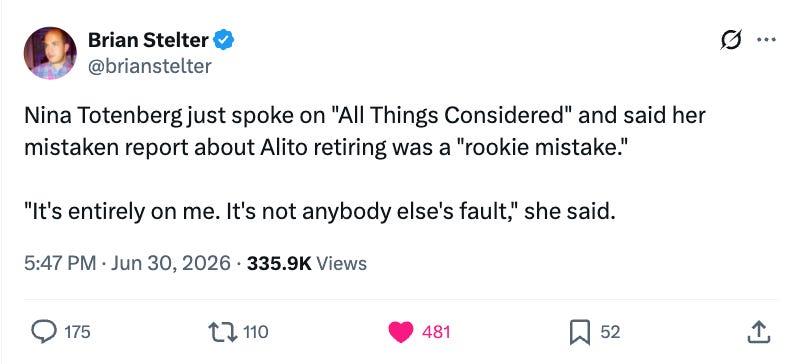
But it’s hard to fault the rest of the market for missing these clues.
Nina Totenberg is a highly respected 82-year old journalist. And as Scott Alexander has noted, The Media Very Rarely Lies. Crazy, I know, but it’s true! In fact, you have to go pretty far back in history to find a precedent for a mistake of this magnitude in a mainstream outlet4—a frequentist would certainly buy up.
And Supreme Court reporters, in particular, have traditionally commanded a lot of power and respect. America’s favorite economist Tom Sowell even made the case that they have a massively outsized impact on legal outcomes: It’s well documented, after all, that while “Supreme Court justices swim slowly, they tend to swim to the left” — ie, they tend to vote more with the left over their tenures. Desire for favorable press coverage from the likes of NYT’s Linda Greenhouse, Sowell argued, may well be what’s going on, under a model he called the “Greenhouse Effect.”5
Wake Up Call
Polymarket has a separate market, Supreme Court vacancy in 2026?, which applies to any justice creating an opening. It ran up alongside the Alito contract, peaked at 60.5% around 3 PM, then went back down, but only partway. As of this writing it trades at 41.5%, up 17.5 percentage points on the week.
If you back out the Alito-specific probability at 27.5% under a rough-independence assumption, the market is implicitly pricing ~18% chance of a 2026 vacancy created by someone other than Alito, which is notable—that premium was near zero seven days ago. So what’s going on?
Well, as Fisher Black taught us, noise traders are an effective subsidy to smarter traders; they give them a reason to correct the price.
The any-vacancy market has $18,576 in lifetime volume. In the entire week before the Totenberg story, it did $37 in trading and seven trades—essentially dormant. In the sixteen minutes the NPR story was live, it did $5,019 across seventeen trades. The false NPR signal traded a hundred times more volume, minute-for-minute, than the market had seen all week. The scare gave the market a jolt of noise that woke it up: In a flash, it became worth investing the effort to discover the right price.
In mid-term calendar years since 1980, at least one justice has retired or died six of eleven times, a 55% base rate. Pre-Totenberg, the any-vacancy market was already at 28.5%—below that. Certainly the post-Totenberg price is more consistent with these base rates, and with the brand-new Clarence Thomas retirement contract.
What to Watch
Supreme court Justice is a dangerous profession: Three died in office. Of the seven who retired, six announced between March and July, with the announcement clustering at the close of the term. The seventh, Breyer, was leaked by CNN in late January, and formalized on the following morning.
In any case, I’d watch any communication out of Thomas’s chambers, clerk-hire announcements for OT26 (Justices who plan to retire stop hiring), and retirement timing signals in July, when Justices are wont to drop these announcements at the close of a completed term. The info on hires disperses entirely informally, but if you were to make a bot David Lat of Original Jurisdiction is the place that’s known for reporting earliest. The indefatigable Scotus Blog also should have an inkling.
And—theoretically—such considerations would be priced into markets on live cases. Polymarket has an active market on whether the Court accepts the sports event contract case, currently pricing 50.5% for December 31 resolution. Retirement expectations flow into case-acceptance expectations. Watch the pair.
These contracts are functionally binary options. Their prices naturally decay toward zero as expiration approaches—but that decay isn’t smooth. Discrete calendar events like end-of-term rulings and clerk-hire announcements create predictable moments of potential repricing. A trader who models these markets as pure theta is leaving alpha on the table for someone who knows when the term ends, so keep it in mind.
The Greenhouse Effect, if it exists, took decades to move a Justice by a few ideological points. The Totenberg Effect, if we want to call it that, took sixteen minutes to move a Polymarket contract by fifty, and to effectively subsidize another to a much more correct new price.
Maybe Tom Sowell is right and the reporters are just that powerful. If nothing else: It’s worth checking if the first page has errors before you trade off events: Tell your bots!
Disclaimer
Nothing in The Oracle is financial, investment, legal or any other type of professional advice. All odds are time-sensitive and subject to change. Anything provided in any newsletter is for informational purposes only and is not meant to be an endorsement of any type of activity or any particular market or product. Terms of Service on polymarket.com prohibit US persons and persons from certain other jurisdictions from using Polymarket to trade, although data and information is viewable globally.
Even without the context we have now that would be an extremely odd sequence of Supreme Court retirements. For a justice, “retirement” is normally announced before or at the time it takes effect, not four days after it takes effect.
One would think, anyway. Idk do you read NPR?
If anything, given to the abject sloppiness of the article I’d guess the explanation Totenberg proffered is partly cover for a dumber process mistake, in which Totenberg’s role was less central than stated.
The closest modern analogue an informed friend can think of is CNN/Fox misreporting the Obamacare decision in 2012.
One could argue that Sowell’s argument is a limited antecedent of Curtis Yarvin’s concept of “The Cathedral”.
The corporate media tracks the political theater of these family empires after the wealth transfers happen. We map the macro infrastructure weeks before.
To prove the math behind the footprint, look at the systemic blindspots. Over the last 30 days, we documented five massive geopolitical inflections that the mainstream completely missed. While retail investors were fed manufactured hype, our readers used our intelligence to execute prediction market arbitrage on Polymarket and Kalshi—betting on physical reality instead of media noise.
If you traded the physical reality instead of geopolitical fictions, here is what that intelligence was worth:
* **Total market lead time:** 42 days
* **Aggregate Prediction Market ROI:** +1,116%
Stop buying the noise. Access the full data-driven performance ledger here:
https://triggledger.substack.com/p/the-arbitrage-of-truth-how-a-15-subscription?utm_source=share&utm_medium=android&r=8gc1qf