

The NBA Playoffs Are a Different Sport
Adventures in hoops modeling, and why the market is sleeping on these four teams


🦅 Polymarket U.S. is LIVE
Get $20 to trade the playoffs with code “PLAYOFF26”
The NBA playoffs, AKA the part of the season that fans and players actually care about, start Saturday.
Sure, the last six months mattered too, on some level. The playoff seedings were determined by the regular season, and major awards (like MVP) that shape our perception of player legacies will be based solely on regular-season stats and performances.
But it’s undeniable that there is a real gap in meaning between the NBA’s regular season and postseason — perhaps never wider than right now — and that has some pretty big implications for these 2026 playoffs.
This is a lesson I’ve learned the hard way over the years, since my entire career as a sportswriter and analyst has been spent trying to bridge the gap between regular-season data and postseason reality. During my tenure with FiveThirtyEight (RIP), we came up with a number of different ways to tackle this — more on those later — and I currently maintain a simple “two-track” model, which keeps separate regular-season and playoff ratings for each team, adjusting the latter more slowly than the former until the playoffs begin. But no matter your approach, it’s a difficult problem to address, because the data going into any NBA forecast is increasingly polluted by the regular season’s decreasing relevance in the playoffs.
It didn’t used to be this way. On a very basic level, we can see this effect in how the regular season has changed its ability to predict the playoffs over time — and not for the better. From 2000-2009, the correlations for regular-season winning percentage and net efficiency rating (i.e., point differential per 100 possessions) versus team playoff wins1 were solid. From 2010-19, regular-season wins actually improved their predictive capacity, even as net rating fell off a bit. But in the 2020s thus far, both figures have suffered a pronounced collapse:
Granted, there will always be some amount of disconnect between regular-season stats and playoff performance, because the playoffs are a different brand of basketball. While broader trends in the game persist across both phases of the season — offenses have consistently gotten faster-paced and more efficient since the early 2010s — some leaguewide stats either show persistent differences versus the regular season and playoffs over multiple decades, or they didn’t used to… but have begun splitting off recently:
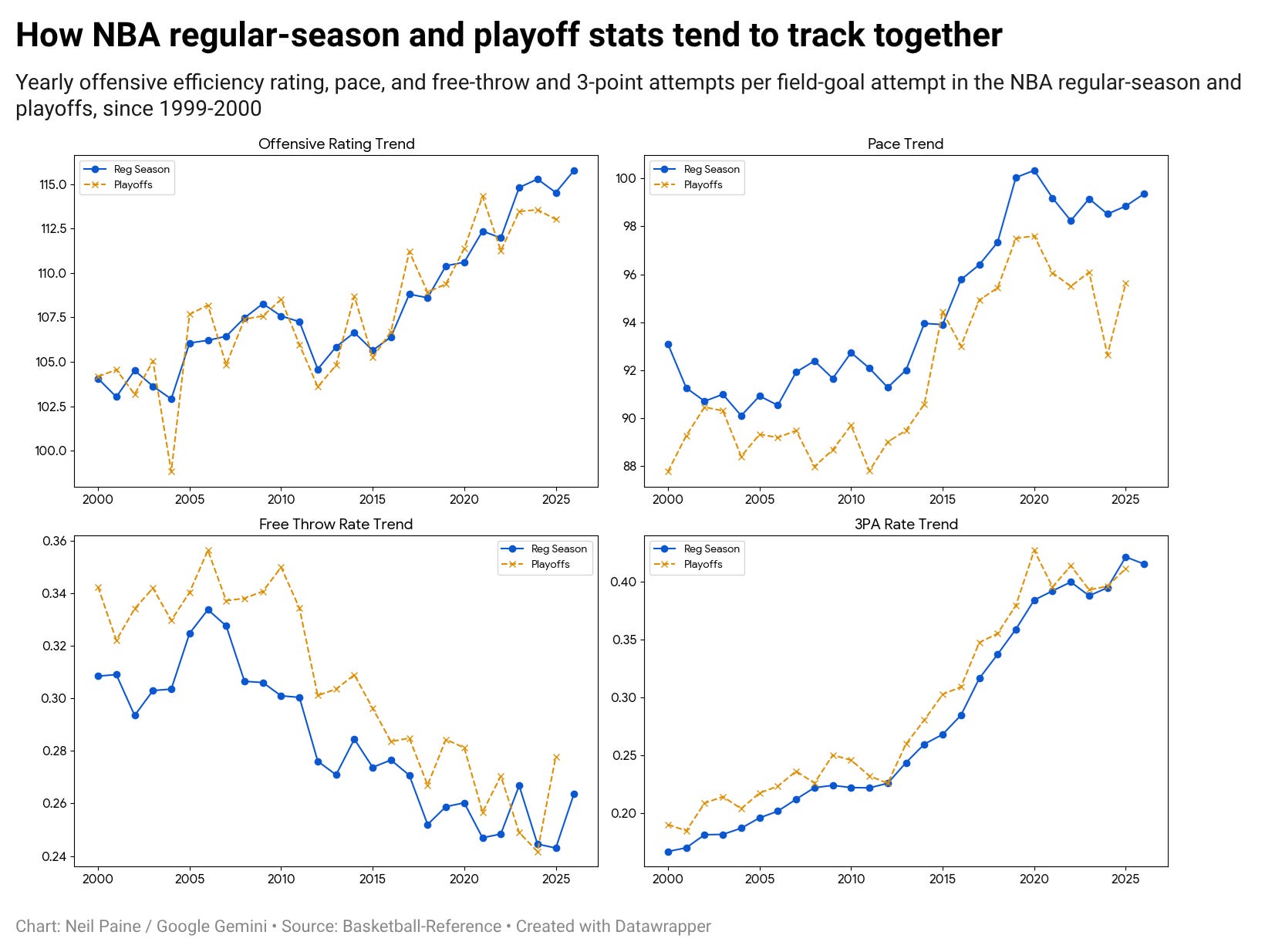
The pace of play, for instance — as measured by possessions per 48 minutes — is always lower in the playoffs than in regular season, and the difference between the two has begun to grow in recent years. Free throws are more common in the playoffs as well. Meanwhile, 3-point attempts (as a share of all shots) used to be more common in the playoffs, but that gap has been erased recently. And offensive efficiency generally tracks very closely between the two segments of the season, though recent postseasons have seen a dip relative to the regular season.
Why these trends and differences? The stakes in the playoffs are much higher, and thus so is the intensity. Teams play harder and with more physicality in the postseason, and they play more deliberately as well.
It would be impossible to sustain this for an entire regular season — particularly considering the league’s worsening problem with star injuries — and there would be no point to it, anyway. The season is plenty long enough for the best teams to at least ensure they make the playoffs. The NBA infamously has a regular-season schedule length, 82 games per team, that is far out of proportion with other leagues in terms of how long it “needs” to be to separate good teams from bad ones. (If the MLB season was as long as the NBA’s, relative to the information each individual game provides in each sport, each team would play around 400 games apiece!)
As a result, NBA teams do not always consistently show us their true talent levels from October through mid-April, a truth that shows up in the form of load management and other phenomena that dilute the signal of the regular season’s sample. Going back to our first chart above, this is only getting worse over time: the regular season is containing less and less relevant information about each team’s potential in the playoffs.
And that’s a problem if you are trying to forecast the postseason, whether you’re doing it for the purposes of journalistic storytelling or finding an edge in your Polymarket trades.
I can remember a time when regular-season metrics actually did a pretty good job of predicting the playoffs. In fact, that was more or less the state of play when I started out at FiveThirtyEight in 2014. But it wasn’t long before we’d find ourselves needing to add more and more bells and whistles to our NBA model to help it keep up, whether it was adjusting for offseason star movement, adding a playoff-experience factor for postseason games, or tossing out team results almost entirely and using player talent ratings (with special playoff boosts for proven performers) instead.
I have no doubt that fellow predictors — whether in front offices or the markets — have followed this same path, and even branched into novel directions from there. It’s a bit of an intractable problem that runs counter to many of the traditional lessons of sports analytics, which emphasized the primacy of big regular-season data samples.
(It’s even spreading to other sports recently, with the L.A. Dodgers looking an awful lot like an NBA champ last baseball season.)
Since I don’t have the bandwidth to keep updated depth chart projections anymore, I switched to the idea of keeping team ratings on multiple tracks — one that leans into regular-season data for the purposes of predicting regular-season games, but another separate rating that doesn’t move much off of regular-season results and focuses on the playoffs. Backtesting shows that this improves upon keeping a single rating for teams — though the drawback is that it may be too slow to catch up on certain teams as a result (witness the San Antonio Spurs’ comparatively low title odds in their first playoff season since 2019).
Looking at this year’s Polymarket title odds versus the two-track Elo model — and taking the log-odds for each figure to make them more visible in a chart — we can see that there are some areas of disagreement, even if the two systems match up pretty closely overall:
If you’re looking for value in the market, the biggest delta that jumps out is around the Boston Celtics, who are 23% to win it all in the Elo model versus just 12% on the prediction market. What accounts for the difference? Because the Elo model is slow to adapt to data from the current regular season, it puts more stock into a team’s long-term playoff record — and these Celtics have a long history of deep playoff runs.
The Minnesota Timberwolves, Cleveland Cavaliers and New York Knicks may also be getting undervalued in this regard, even though they have less playoff experience than the Celtics. By contrast, this is where Victor Wembanyama and the Spurs get less credit than the market is giving them, since they lack that record of experience.
The important — and counterintuitive — thing to remember is that what we’ve seen of these teams over the past handful of months may not actually matter very much. So if you’re going to make smart trades from here, you must recognize that the NBA playoffs have become less a continuation of the regular season than they used to be — and more of a separate ecosystem entirely, where certain teams are built for what comes next more than others. It’s your job now to identify who those teams are before the market catches up.
* Neil Paine is the proprietor of Neil’s Substack, a newsletter that looks at all sports through the lenses of both analytics and storytelling. He is also a freelance writer for a variety of outlets — and before that, he was the sports editor at FiveThirtyEight and an analytics consultant for the NBA’s Atlanta Hawks.
Disclaimer
Nothing in The Oracle is financial, investment, legal or any other type of professional advice. Anything provided in any newsletter is for informational purposes only and is not meant to be an endorsement of any type of activity or any particular market or product. Terms of Service on polymarket.com prohibit US persons and persons from certain other jurisdictions from using Polymarket to trade, although data and information is viewable globally.
As a share of the maximum possible wins that season (15 before 2003 and 16 since then).
The Boston Celtics are your best bet to win the NBA title at 23% according to the model versus 23% at 22 dollars on Polymarket. With all of the requisite playoff experience and chops at getting it done in post season play, the Celtics are your best bet currently while regular season stats undervalue experience before the smart money gets to move the line.
I'm generating some arbitrage ideas and making them public. https://substack.com/@long2sleep/note/c-247706932