



Werner K. Zagrebbi is a board-certified Superforecaster (TM) who writes about politics and economics at Right Rationalism.
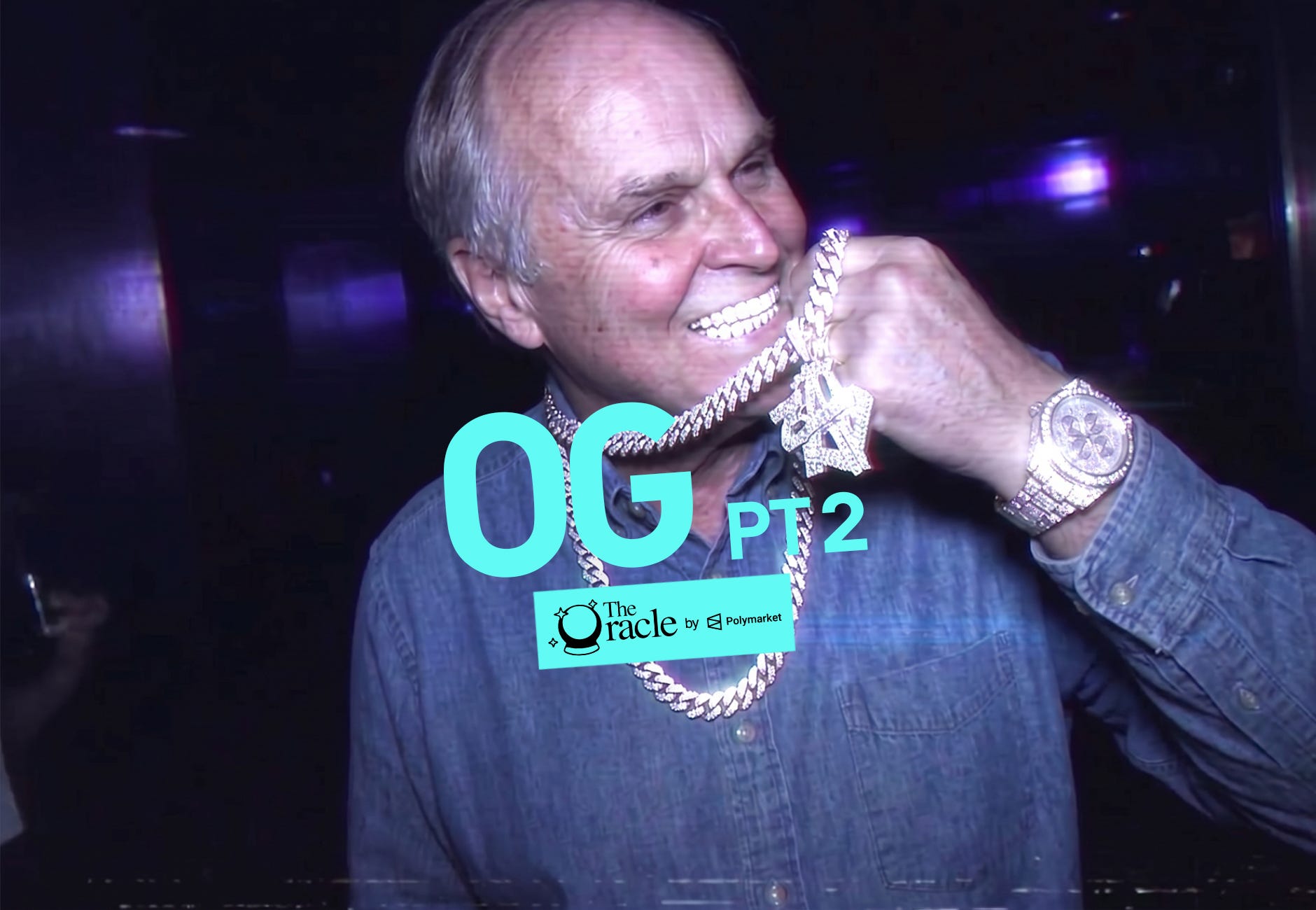
GMU professor Robin Hanson arguably invented modern prediction markets. Here’s part two of his interview with The Oracle (read part one here!).
Your logarithmic market scoring rule from 2003 is the ancestor of every automated market maker in existence, including the crypto ones moving billions of dollars. And Polymarket runs an order book, not your subsidized market maker. How should people trade it?
There are different trading strategies. The simplest: ask what’s true about the world, compare that to the price, and ask where you think the price is wrong. Then ask, what’s the chance other people don’t know this thing that I know? You shouldn’t just compare the world to the price, because maybe the price is based on things other people know that you don’t. Look for pieces of information you have that other people are not likely to have, so it’s an addition to the price, and trade on that.
Another strategy, very popular, is to look for deviations from random walks and move prices toward a random walk. A third is to be a market maker, which is what Polymarket and others pay people to do: pay attention to the market microstructure, sit on both sides with buy and sell offers, and take profit on the difference. My simple automated market maker was just giving up on that. I designed a market maker that doesn’t lose too much money, not a clever one, because if I made it clever, people more clever than it would take advantage of it. These professional market makers are smart enough to be clever.
And the actual finance game is this: if you set a really strong academic reluctance to believe, by the time you’re finally convinced there’s a pattern, somebody else will have used it up and there will be no profits left for you. So professionals have to be more aggressive, which means they’re wrong a substantial percentage of the time, and then it’s all about judgment. When finance companies hire people, it’s all about whether they trust their judgment to decide when there’s enough evidence to act. That’s what we’re all betting on.
Would we have a better world of ideas if more places gave status to contrarianism?
I doubt it. But I think I have found a secret to being a contrarian who’s usually right. The world is full of intellectual silos. The people in each field roughly know the newspaper version of other fields, and they learn the expert version of their own field. And often the expert versions of different fields are just in conflict. You only learn that if you study multiple fields at the expert level. When you find the conflict, there are usually not many ways to resolve it, and usually you can tell who’s right: who has dug into more detail, who has more solid theory. If you embrace that resolution, you are contrarian with respect to the field you’re saying is wrong. And your edge is that they refuse to listen to the other field. When a field hears its results conflict with another field, they deny the conflict. So this is how you can be consistently right and contrarian. There’s intellectual progress just waiting: combine different fields, notice when they’re in conflict, resolve the conflict. That’s something LLMs have a real potential for in the coming years.
This may be kind of annoying, but how would you use this to trade? Because you probably could, right?
Later on, when we have prediction markets on many more topics, you could go look for these intersections and trade on them. Unfortunately, the current range of prediction markets is pretty narrow. But if the people trading in a particular market are all from one discipline, you might ask: what other discipline has expertise relevant to this, and has it been consulted? You’re typically asking: the market has some information in it. Where is that from? And what information could I find that’s not in the market? Look for unusual sources of information that other people in the market haven’t been looking at. That’s one way to have an edge.
Joe Weisenthal wants to know: how important is it that a forecaster can show their work? Broader version: do prediction markets incentivize you to hoard your information instead of publicizing it? You used to get a status reward for writing the article. Now you can just get a payout for silence.
Prediction markets most directly give you incentives to trade, and that’s not a direct incentive to explain your reasons. But the simplest way to make money on information is: you have a piece of information, you trade on it, you reveal the information, the price comes to accept it, and now you can undo your trade and go on to another trade. The major cost of trading is the opportunity cost of the assets you trade. To minimize that, you want the shortest possible time between when you trade on the information and when you get to undo the trade because everybody else agrees. So mostly you want to reveal, not hoard.
The exception is when there’s a big distance between your piece of information and any market you can trade in. Then you’re tempted to hoard it. The more directly you can trade on the information, the more you want to just reveal it and get on to the next thing. This is a reason to like combinatorial markets: a stronger, more direct relationship between the information you have and the markets you trade in. And all information has a duration: the expected time before other people get it. The longer you have it exclusively, the more money you can make, but the longer you have to lock up your money too. So what you really want is to trade as much as you can on your information, reveal it, and be done.
Could you explain combinatorial markets?
An ordinary prediction market gives a probability or expected value for some particular event. In principle, what you really want is a full joint probability distribution over all possible events. That’s what statisticians use, what game theorists use, what decision theorists use. These markets are only giving you marginal distributions, not all the correlations and connections between everything. Hedge funds generate their own joint distribution in the background, their model of the world, and use it to decide where to trade in these particular markets. But it’s actually surprisingly possible to just have a market that represents a full joint distribution over everything.
The key thing is that the full joint distribution has an exponential explosion in the number of parameters. So you need a reduced-form representation. One common representation is a Bayesian network. Roughly ten years ago, I and some colleagues here at Mason made a combinatorial prediction market with over a thousand variables connected in a Bayesian network. It was called SciCast, and DAGGRE before that. And a key theorem I proved early on: if you have a set of base markets with some liquidity, and you introduce all possible combinations of them, how much more liquidity do you need for all the combinations? The answer is zero.
How do you not need any more liquidity to run this market times that market?
Think about the worst case. When you fund a market maker, the worst-case loss is the price going from the middle all the way to an extreme and never coming back. Say you have N markets with the same liquidity: your worst case is N times that. Now make it a full combinatorial market. The worst thing that can happen is you go to the corner of the combinatorial space, which is exactly the corner where each individual market has gone to its extreme. And that turns out to be exactly the same total loss. The problem of combinatorial markets is the computation, not the liquidity.
So a fund with a full model of the world could just trade the whole thing directly.
Once the markets are combinatorial themselves, you can take your combinatorial belief and just directly go trade on it. That’ll be a thing. I do think in the long run there will be combinatorial financial markets, and typical hedge fund practices would change a lot in the face of them.
Let’s play overrated or underrated: play money prediction markets.
They were overrated, but now they’re probably correctly rated. Once Polymarket and others showed up, the demand for play money markets went way down. Which is roughly correct.
Sports as the gateway drug to prediction markets.
Sports betting is one of those things where, once they had legal permission, they went for it because they knew there were a lot of customers there. It’ll lower infrastructure costs and set legal precedents and make customers familiar with things, all of which is good for the other things prediction markets will want to do. It’s not my priority, but I don’t mind it, and it will help the things I’m working for.
The GMU econ intellectual culture.
I’m too close to that to rate it. Mason is a collection of contrarians who have somewhat different contrarian takes. When I’ve been contrarian on issue X, other people at Mason say: gee, we don’t want to be associated with X, that’s not how we’re contrarian. A coalition of contrarians each wants the others to be less contrarian, to give them room to be more contrarian. Most contrarians’ stance is: those guys really are contrarians, I’m really not. The world is going to come over to agree with me, but not with them. And as soon as the world recognizes me, I’m leaving them.
Base rates.
It would be hard for them to be overrated. We can’t rate them highly enough. Most of the time, base rates are what gives you your answer. Most of the time, people are trying to add some correction to a base rate, and they’re overcorrecting. Just the base rate, guys.
One of the central questions about contemporary prediction markets: why is there so little real hedging yet? Is it culture or something structural?
A few decades ago, regulators said: we don’t want to allow prediction markets because they’re too small to support hedging. Markets need to be big to hedge, and if they’re big they need heavy regulatory oversight. That’s why the world just did not legalize prediction markets in the early part of my life.
I do see lots of opportunity for increasing hedging, but I still think the total demand for hedging in the world isn’t that large. And here’s the thing: jobs are a form of insurance. If you as an employee were just paid your actual productivity every week, you would face a very uncertain and often negative payment. When we give you a job, that’s insurance. The company is taking on your risk and you get paid a salary. It’s probably the biggest form of insurance we have in our world, and it doesn’t show up in the insurance markets. It’s not called insurance.
And famously, people face a lot of big risks they don’t want to insure. Career risk. Marriage risk. Risks about whether they’ll be proud of their kids. When life insurance first rose up in the late 1800s, it was kind of a random marketing trick: you’re an irresponsible husband if you don’t have life insurance to cover your family if you should die. It was sold as responsibility.
Well, it’s not hard to figure out. There’s a massive first-mover status disadvantage to being the guy who hedges his divorce risk.
Signaling is often at odds with insurance. People want to signal confidence, and they want to signal that they have prospects. That’s often a good explanation for why people don’t insure. But then all the insurance we do have, you wonder: why didn’t signaling block those? Why aren’t you ashamed to be an employee, not showing confidence in your own productivity?
That one seems clear: in most industries you can’t assess productivity that easily.
Do you expect AI superforecasters to go dramatically past the human frontier?
I don’t actually much care. Prediction markets should be robust to participants. The cheaper participants can be accurate, the more the price of information falls, and the main attraction of this institution is that it plausibly has a lower price of information than the alternatives. But if AI has an advantage here, it probably also has an advantage elsewhere. So it’s not obviously going to make this institution better than the alternatives. It’s going to make them all work better.
You’ve said you pick your battles where adoption of prediction markets is likeliest. I’ve thought of a new application: the futarchic interview. A market on each question, conditional on this one being asked, how many likes on Substack?
To get scale, I would want to advise a whole process rather than each interview. Marc Stiegler had a science fiction novel [Earthweb] where an alien ship is attacking Earth, we sneak some people aboard, and we have betting markets on Earth telling the team on the ship where to go left or right and what to do next. That’s the model: betting markets advising a team making individual choices. The hard part is that any one interview isn’t worth enough to have a big audience for it. You’d want something with high enough attention that people could specialize in advising it, like markets advising the choices in a high-level chess game.
But it’s not one of the first applications I’d advise. What I look at first in the world is: where are we making decisions where other people nearby say, those are bad decisions? People grumbling that whoever’s making the decision has no idea what they’re doing. That grumbling is a hint that there’s a failure to aggregate information. I don’t know that we hear that about interviews. We should smell a problem. Something should stink a bit.
In some sense you’re complimenting me. It’s not as bad as CEO hiring.
Actually, when people do podcast interviews with me, I typically tell them: you’re not challenging me enough. You’re not disagreeing with me enough. This is boring. They have their list of questions to get through, and we’re not arguing over things.
What’s your most underrated idea? You should have a view. Who’s in a better position to judge?
In my mind, the most underrated thing is what I’m doing right now, cultural drift, because I’m an obsessive person, focused on what I’m obsessed with at the moment. But I’d say my best idea is futarchy, decision markets. That just obviously has the biggest potential to make the world better.
Is anyone actually running one?
There are crypto companies being run with decision markets now. So far they’ve done great. I’m excited for that and I try to help them.
Final words of wisdom? Anything you want to say to our readers?
When I was young, at this project trying to make the World Wide Web, we succeeded in influencing the World Wide Web, and I was just a junior person on the project. But what I saw was that the people who had actually taken a chance, had a vision, and succeeded in implementing it and making the web happen, they didn’t win much in the world. They weren’t famous. They didn’t make money. They just had the satisfaction of knowing that they made a big difference. And if my old friend Hal Finney made Bitcoin, he also did not make money on it. Maybe he’ll get fame, maybe not. But he had the satisfaction of knowing that he had a big impact.
I was warned early in life that it’s actually more possible than you might think to have a big impact, mainly because the people who have the big impact don’t actually get that much out of it. That’s the trade-off. It’s easier than you might think to have a big impact on the world, exactly because you might not get much from it personally.
To what extent is your whole intellectual project trying to let people internalize more of the gains for making an impact?
People who make bigger, better things happen should get more gains from it. Prediction markets are certainly a part of this, a way to try to make that happen. But they have to happen in a world that doesn’t yet reward that so much. That’s my high-level advice. But in any case, I can be proud of what’s happened, and of having had an influence.
Disclaimer
Nothing in The Oracle is financial, investment, legal or any other type of professional advice. All odds are time-sensitive and subject to change. Anything provided in any newsletter is for informational purposes only and is not meant to be an endorsement of any type of activity or any particular market or product. Terms of Service on polymarket.com prohibit US persons and persons from certain other jurisdictions from using Polymarket to trade, although data and information is viewable globally.