


This is a cross-post from Polymarket Institutional Research. To receive future issues, sign up here.
Polymarket’s Institutional Desk is facilitating block trades for JetBlue bankruptcy event contracts on both our U.S. and international exchanges. Contact Brooke Rizzetto at institutional@polymarket.com for onboarding.
By Jon Turek
Warren Buffett famously said that airlines have devoured capital since the Wright Brothers:
“If I’d been at Kitty Hawk in 1903 when Orville Wright took off, I would have been farsighted enough, and public-spirited enough — I owed this to future capitalists — to shoot him down.”
Since the 1970s, the US airline industry has produced almost 160 bankruptcies. The problem with airlines from an equity or credit perspective is that they are thin margin businesses with high fixed costs and volatile variable costs. The business model is very dependent on scale. Which is why, for these past few decades, the airline industry typically cannibalizes itself, as the acquirer aims for increased scale and the acquired is in financial trouble from not having it.
JetBlue, over the last couple of years, tried to execute this rollup strategy. Up until last year, they put in a good-faith effort to buy Spirit Airlines. That was struck down by antitrust regulators and Spirit went on to declare bankruptcy in 2026.

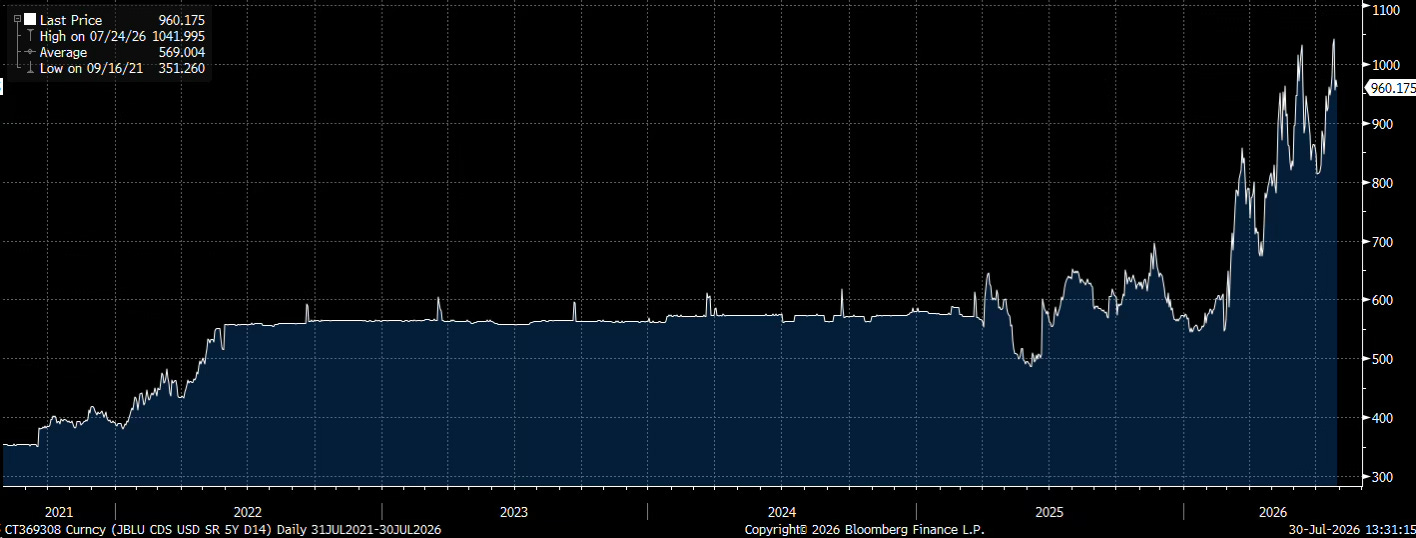
This failed move by JetBlue has left them in a very awkward place. The financial markets are saying this with 5y CDS on JetBlue bonds (chart below) trading near 1000bps, but the left tail on Polymarket is still quite cheap. Which is interesting in light of a very tricky backdrop for JetBlue.
Without the Spirit acquisition, JetBlue is stuck in between the big guys (Delta, United) and the budget airlines. They are too big to be a discounter but they are not big enough to compete with the network economics (pricing, routing etc.) of the big guys. And the big guys have been able to move up the pricing power curve with premium traffic.
This imbalance can be seen in the recent labor talks going on at JetBlue. United and Delta crews just landed deals that were 34% bigger than what JetBlue is currently offering its crews. That shows that JetBlue cannot match the market.
The financial picture right now is hairy for JetBlue. They have $9.3B in outstanding debt, with most of the fleet already pledged as collateral and a CCC credit rating. Their interest costs alone are running at $800m a year. They have very little room to maneuver, and it doesn’t seem like a sale is viable now.
Within this very tight operating window, the headwinds to the business more tactically have increased in recent months. Jet fuel prices have surged following the war in the Middle East. They have negative pressure from Pratt and Whitney engine issues disproportionately impacting JetBlue’s Airbus-heavy fleet. And, they are the most exposed large carrier to fall weather disruptions, as they have a heavy Florida/Caribbean fleet concentration.
This could bring forward some interesting tactics around managing their debt position. It is possible that declaring chapter 11 early, could make it less likely that they have to declare chapter 7 later on. This would keep the company operating instead of it being forced to liquidate like what happened to Spirit.
An interesting trade on Polymarket right now is that this left tail of JetBlue, that financial markets are pricing quite seriously with CDS near 1000bps (10% notional per year to insure against default), is only modestly priced in prediction markets. In “Which airlines will announce bankruptcy by December 31, 2026?” “Yes” for JetBlue is around 4%. That seems like an interesting opportunity in a relative value sense to traditional credit markets but also given the left tail dynamics in the business over the second half of the year.
Related Polymarkets
Disclaimer
Nothing in The Oracle is financial, investment, legal or any other type of professional advice. All odds are time-sensitive and subject to change. Anything provided in any newsletter is for informational purposes only and is not meant to be an endorsement of any type of activity or any particular market or product. Terms of Service on polymarket.com prohibit US persons and persons from certain other jurisdictions from using Polymarket to trade, although data and information is viewable globally.
Left-tail markets are a regime tell. The scarce edge is deciding which defensive stacks still work when the cycle turns.
https://paretoinvestor.substack.com/p/benner-cycle-2026-market-crash-warning-defensive-strategy
Interesting one. I guess Poly traders are still taking into account that JetBlue can still raise money from existing investors (although at much higher cost now and spreads will continue to rise as uncertainty lingers) or continue pledging their existing PPEs to ride through 2026.