



On September 3, Polymarket launched Perps, its perpetual futures exchange. Perps let traders go long or short individual stocks, indices, crypto assets and commodities with up to 20x leverage and no expiration date from the same balance they use for their polymarket.com prediction trades.
After the launch, we caught up with Xtine Fang, Polymarket Perps Lead, to talk what’s next for the perps product and do a little whale watching.
This interview has been edited for length. All answers are her own.
Why does Polymarket need perps? What’s the open space in the market?
The idea is to have a single house of all finance. We have this killer feature where you can trade stock and crypto perps because we began as a prediction market. We can offer a place for users to trade everything in one place, without having to withdraw funds to another exchange and go through a lot of transaction fees.
The other big differentiator is speed of listing. We listen to what users want, and we list very quickly. Previously it was semiconductor names, then the photonics names, a lot of crypto beta names, as well as crypto stocks like Circle. We’re very much catering to what the user wants. We also have Asia equities like CXMT, which is extremely topical, as well as stuff like Alibaba.
What’s being traded the most so far?
The top ones are still the crypto majors like BTC and ETH, especially over the past week where we saw the market rebounding. But previously, when BTC was stuck in the $62k-66k range, we saw a lot more volatility in the Korea semi names like SK Hynix and Samsung, and other semi names like Micron.
Who are the top perps traders right now? What do we know about how they are trading?

Since it’s a DeFi exchange, all the trading data is open to the public, and there’s a leaderboard where you can see all the top traders.
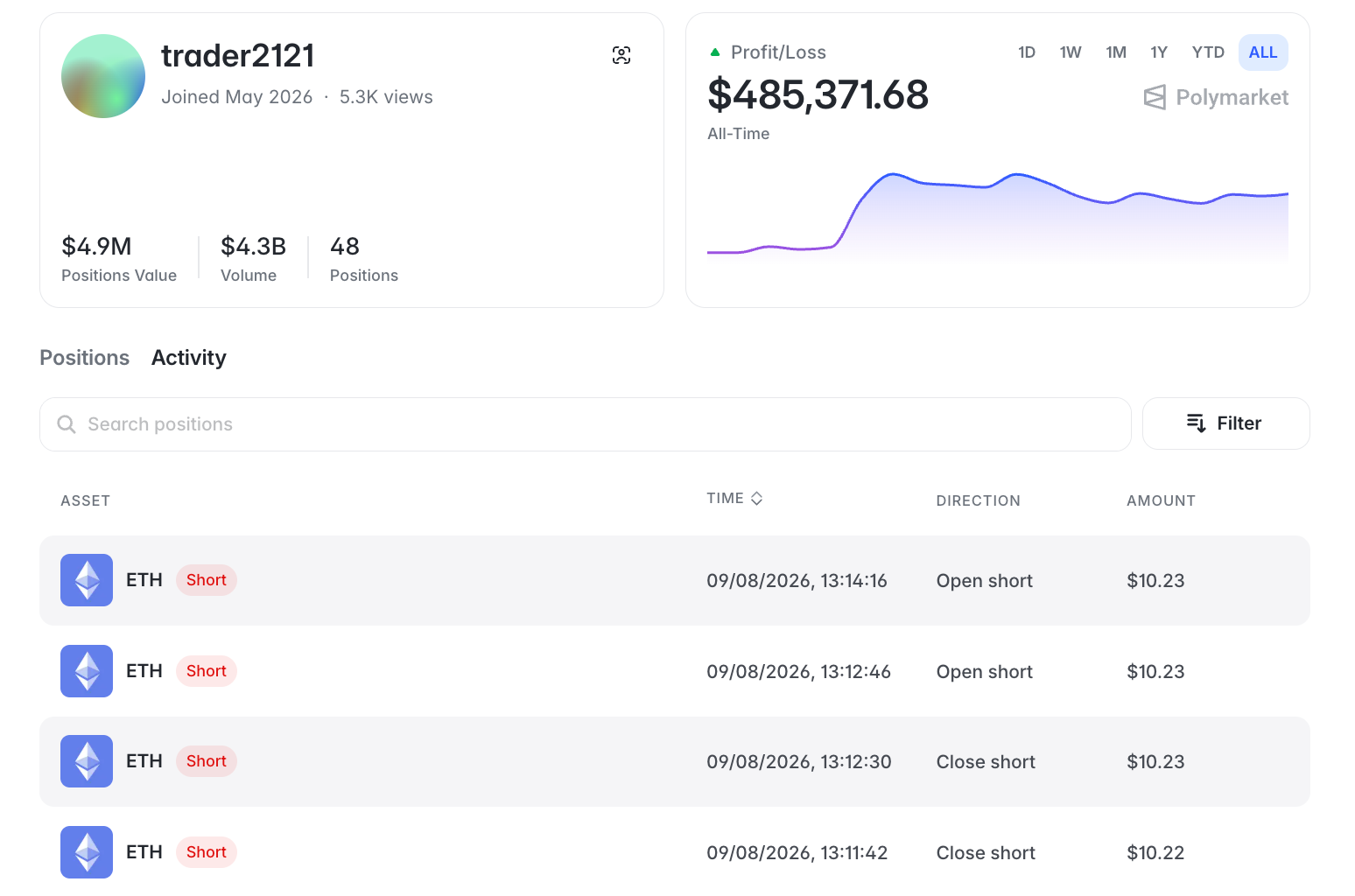
We have one guy, trader2121 who’s up almost $500k. I tried to email him and get in contact but he never replies. Maybe he’s scared that I’m a CIA secret agent.
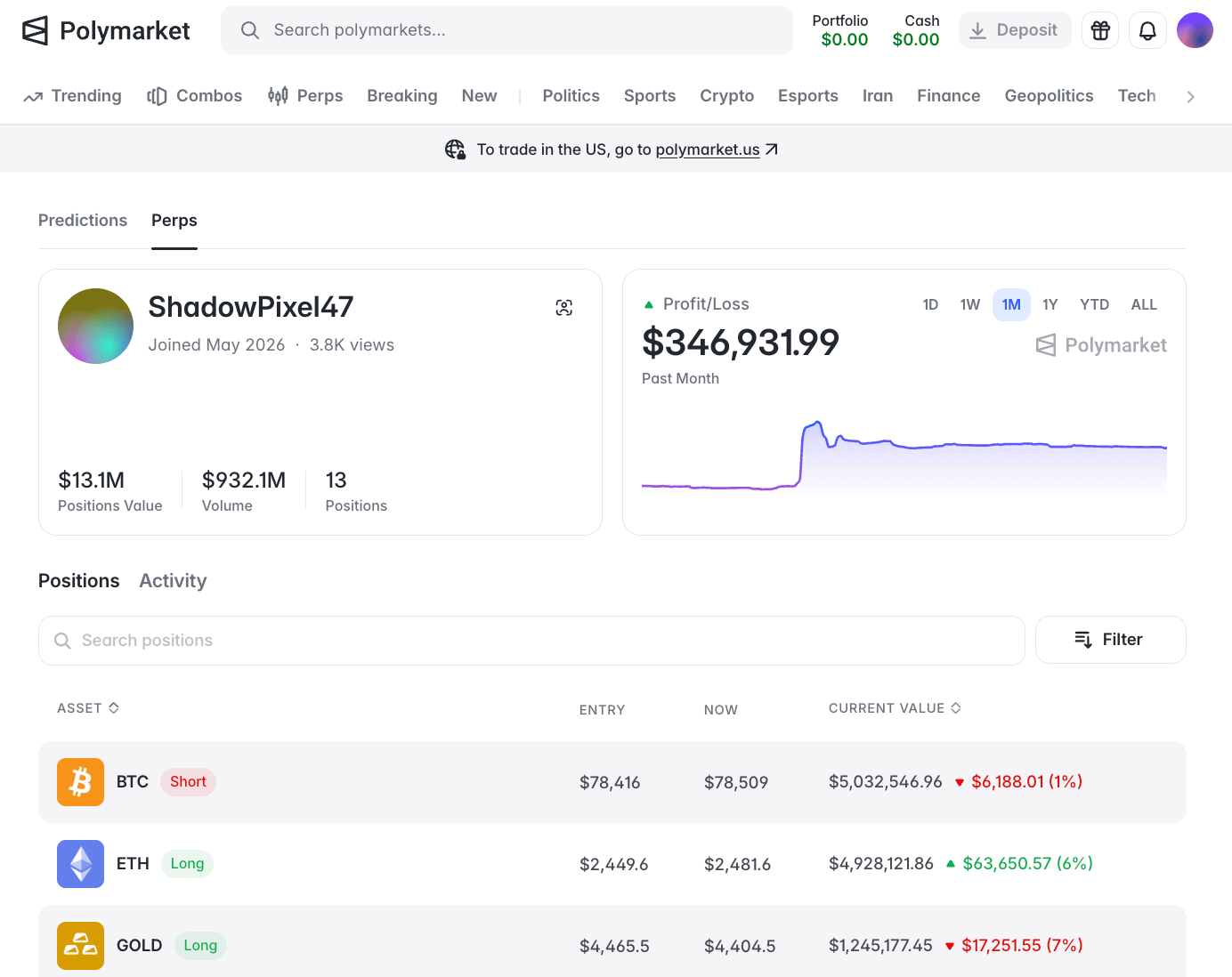
The top perps wallet, ShadowPixel47 looks like a large market maker firm, with dozens of trades per day. But they have also had a large Long ETH / short BTC position that has performed very well since late August.
Anything you see the best traders do differently?
The smartest traders generally trade event driven stuff very well: betting into FOMC, positioning into earnings like SanDisk, taking leverage off after the huge semi rally, and then shorting at the right time. I can probably pull up some data for you.

One tool that could be useful for this is Polymarket Calendar. They made a calendar, and for each day it shows which events you can trade. We also have an earnings calendar for public companies on Polymarket.
Are you noticing people do perps trades along with a corresponding Polymarket event contract? What’s the crossover in user activity between perps traders and OG Polymarket traders?
That is the ultimate end goal, successful cross selling to our Polymarket users. I haven’t seen it yet because perps is so new. But that’s the end goal, and it’s something a lot of our smarter traders have brought up.
Anything surprising you about how traders are using the product?
The more surprising thing was I thought people were no longer interested in trading crypto, but there were still a lot of people asking me to list UNI, AAVE, and Morpho, all those names, even when crypto wasn’t doing very well. You have this diehard crypto native segment that trades almost solely crypto. Even when we’re in a roaring bull market for AI and semi stocks, they’re not trading that, because they think that’s not their edge.
What’s the max leverage you can get? How is it set for the different assets?
It’s different based on each contract. On BTC the slider goes to 20x. Then we go to stocks: Micron’s leverage is 10x. Generally the RWA stuff is around 10x and the crypto offerings are around 20x.
How do the trading fees work with perps?
Our fees are very friendly right now. We’re so new and we want to be competitive, so our fees are better than Hyperliquid, maker and taker.
The way it works: every fill has a maker and a taker. If you place a limit order that rests in the book, you’re the maker, you’re adding liquidity. If you hit an order that’s already sitting there, you’re the taker, you’re removing it. Takers pay more because they consume liquidity.
The fee is charged on the notional of the trade, price times quantity, and it’s paid in pUSD. Everyone starts at 0.04% taker and 0.0125% maker, so a $10,000 taker fill costs you four dollars. From there it’s tiered by your trailing 30-day volume, and tiers get re-evaluated every day. The rates keep dropping as you trade more, and at the very top tier, $1 billion in volume, makers actually get a rebate. We pay you half a basis point to quote. Accounts from the beta are also on the top-tier schedule for now, regardless of volume.
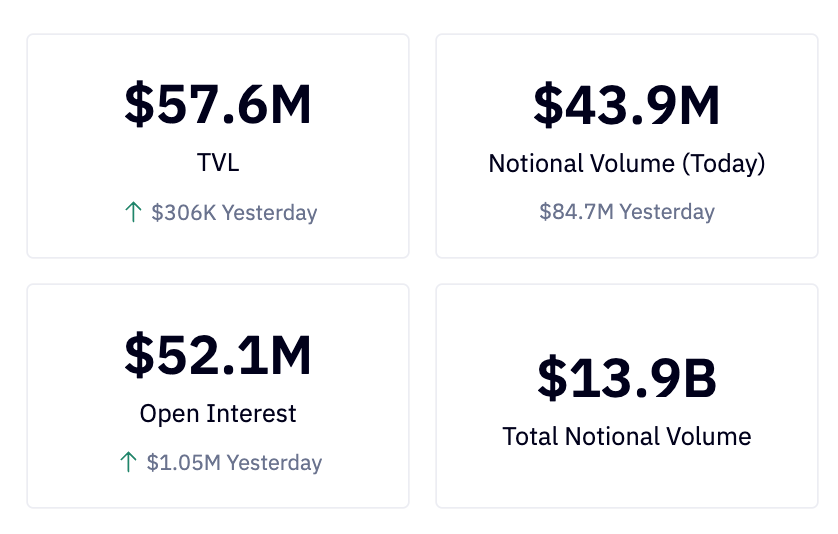
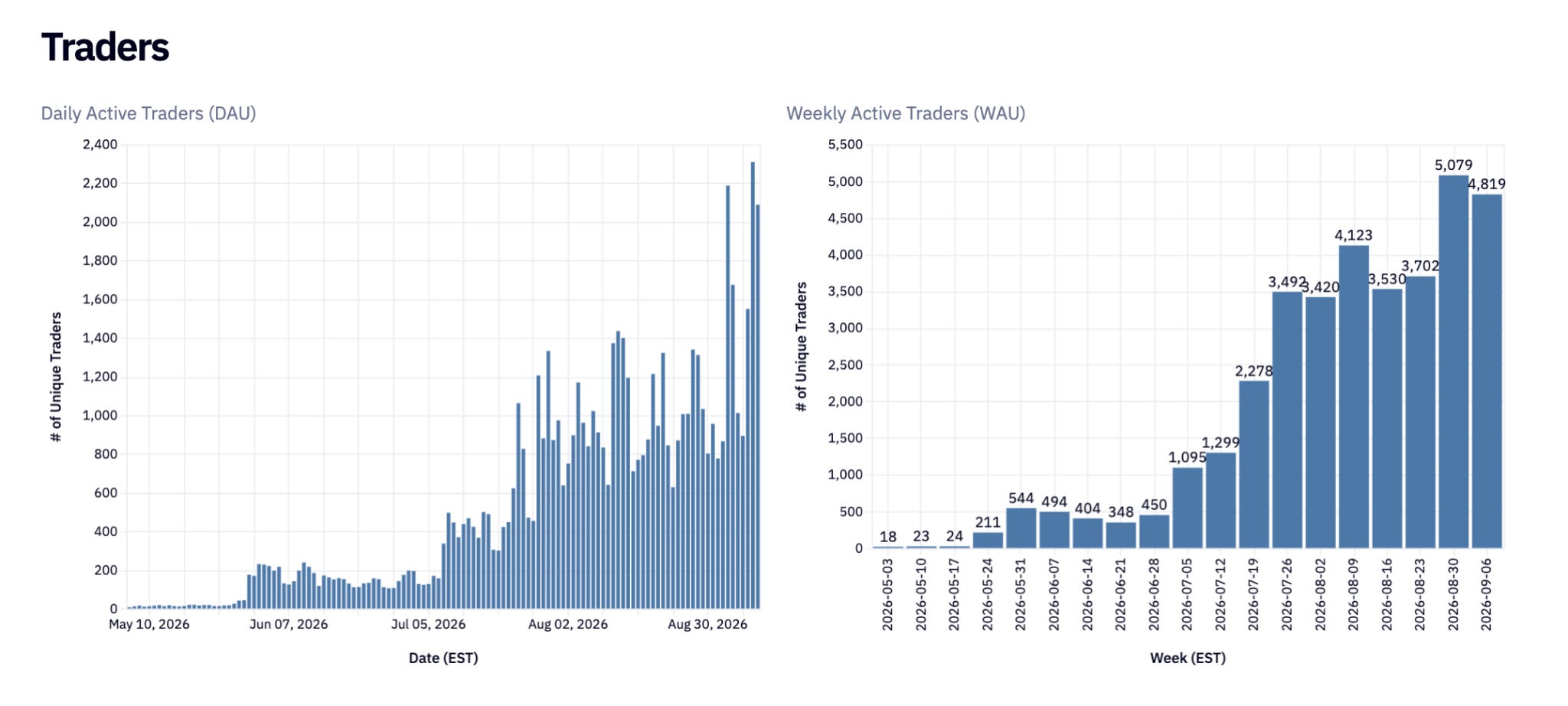
We had the public launch last week. How has the volume been?
I’ll send you some charts.
I know there’s been a lot of requests for leverage on things like “Democrats to win the House” and the traditional events contracts. Have you thought about that? Is that something perps could do in the future?
The genuine answer is I’m not sure, because that’s more on the prediction market side. For the perps side that I’m in charge of, we want to be more like the traditional perp exchanges, where we list the traditional assets and the cryptos.
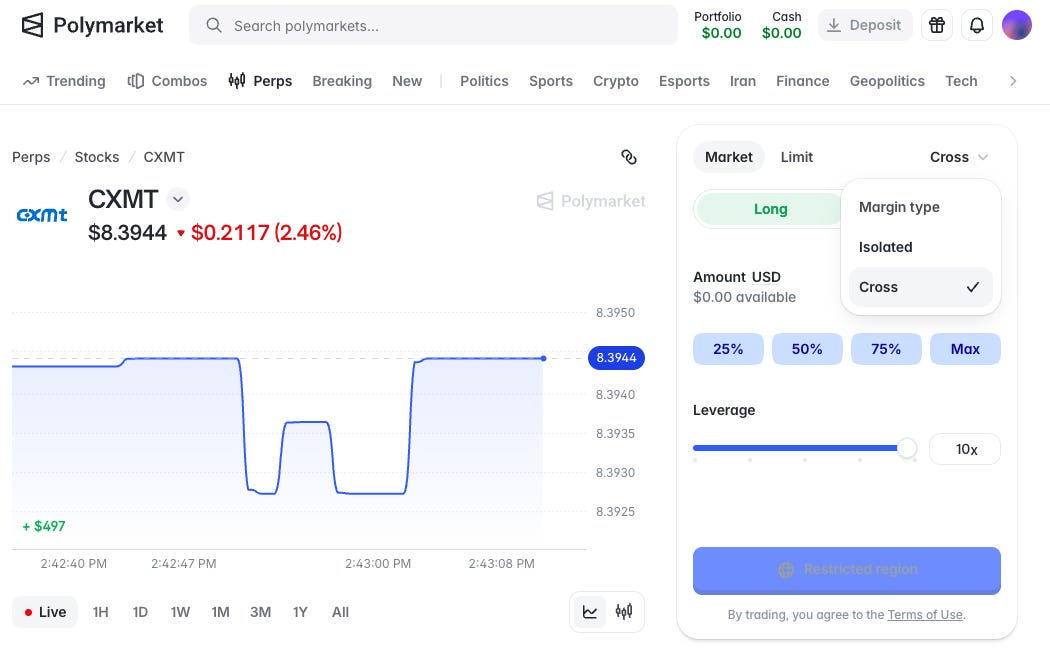
A unique offering we do have is cross margin, where a single balance collateralizes positions across multiple markets. A lot of the assets that are isolated margin on Hyperliquid, we have cross. Take CXMT, the recently listed ChangXin Memory, a very popular Chinese semi name that IPO’d recently. Other venues would only offer something like that as isolated. We have it cross.
On any market, you pick a market or limit order, choose isolated or cross, and then there’s the leverage slider: how much money you have on your balance, if you want to full port that at 10x and slide it out.
What are you seeing generally in the market? Is crypto winter over?
Let me put it this way. It’s currently still a very fast money driven bounce, and we’re squeezing pretty hard to make it more sustainable. Let’s see if we can keep BTC in the $80s for a while, and if Trump doesn’t say anything silly. Before Polymarket I was at a crypto liquid fund, so I know a lot of funds were literally shorting in the hole. They were shorting BTC at the $62-$67k levels, and they were really caught off guard by this rally. A lot of short covering is sending us higher, especially on the BTC and ETH front. And I think interest has generally come back to crypto. There were a couple of centralized exchanges, tier three exchanges, that were going to shut down in the past month because there was no trading volume. Now at least one, BitMart, wants to resume operations.
What about interest rates? Shouldn’t we have Treasuries, the 10 year, the 30 year? That’s been such a macro narrative.
We could. But I like to think of our current user base as younger degenerates who trade based on following FinTwit, or Reddit, following Citrini, that kind of thing. Interest rate products are another world that doesn’t really interest them that much. They would rather follow an SK Hynix bull post and just long SK Hynix at 10x.
Hugo Martingale asked me to ask when we’re listing Fartcoin?
Fartcoin, that’s a good one. Fartcoin is Sol beta, but not a lot of people are trading Fartcoin anymore. People treat Pump as the Sol beta now. Pump has a lot more traction, so we have Pump. I looked at volume on Fartcoin. Previously, whenever the market recovered, Fartcoin would bounce so hard, but now that’s not the case. I think the market just lost interest in Fartcoin.
Polymarket Perps tldr:
Leverage. Up to 20x on major crypto pairs and around 10x on most equities. Max leverage is set per asset.
Cross-margin. A single balance can collateralize multiple perps positions, including assets that other venues restrict to isolated margin.
Fees. Fees are charged on a volume-tiered structure by trailing 30-day volume and calculated daily. Taker fees start at 0.0400% and fall to 0.0200% at the top tier. Makers start at 0.0125%, and the top tier earns a 0.0050% rebate. Full fees info.
Exchange. Central limit order book (CLOB) with funding payments that anchor contract prices to the underlying index. Margin and liquidation run on a mark price that tracks an asset’s price across multiple venues. All trading collateral is in pUSD, Polymarket’s native stablecoin.
Always on. Markets trade around the clock. Price feeds shift across trading sessions (regular trading hours, overnight, weekends).
Transparency. Every account’s positions and trade history are viewable on its public profile, the same way other DeFi perps exchanges work.
Builders. An API supports trading bots, market making systems, portfolio dashboards, and risk monitors.
Disclaimer
Nothing in The Oracle is financial, investment, legal or any other type of professional advice. All odds are time-sensitive and subject to change. Anything provided in any newsletter is for informational purposes only and is not meant to be an endorsement of any type of activity or any particular market or product. Terms of Service on polymarket.com prohibit US persons and persons from certain other jurisdictions from using Polymarket to trade, although data and information is viewable globally.
👀
Let’s get this leveraged bread