




This is a cross-post from Polymarket Institutional Research. To receive future issues, sign up here.
The Polymarket Institutional Desk offers block trades on US and international exchanges, institutional market maker relationships, and enterprise data services. Contact Brooke Rizzetto at institutional@polymarket.com for onboarding.
On July 31 at a Camp David meeting, Scott Bessent had only one item written down on his to-do list: “Buy Japanese Yen (JPY) $5-10 bil.”
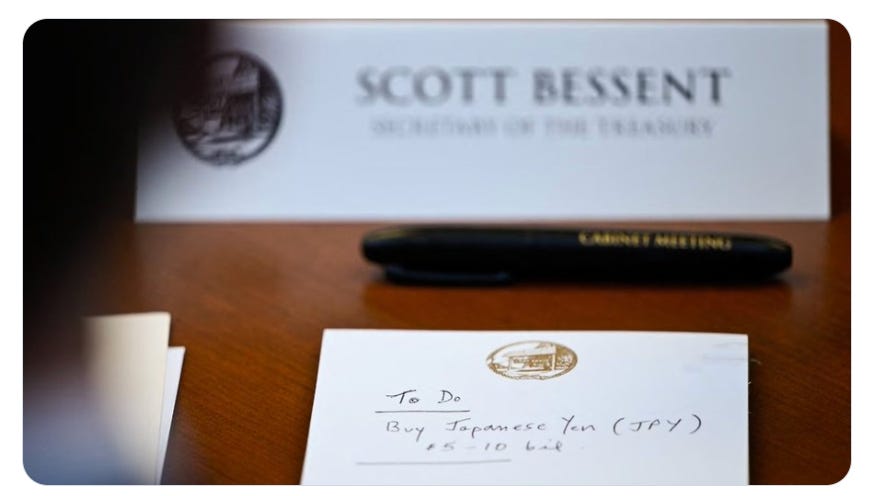
One day earlier, the yen had just hit its weakest level against the dollar since 1986, and Washington and Tokyo responded with the first coordinated currency intervention since the 1998 Asian Financial Crisis. This intervention saw USD/JPY pull back from 164 to 155. In the two weeks since, the $88 billion effort looks misspent, as the yen has slid back above 159.
Polymarket traders are now considering the risk that Bessent was trying desperately to avoid: could the largest funding trade in the world be starting to unwind?
Borrowed time
The yen carry trade is simple: borrow cheap yen, convert to dollars, buy higher yielding assets, pocket the difference. Japan’s policy rate is 1%; the Fed’s upper bound is 3.75%. Traders have gorged on levering up this trade as the yen continued to weaken.
But the setup is precarious: when the yen strengthens, borrowing gets more expensive and leveraged traders get margin called. Covering means selling dollar assets and buying yen back, which strengthens the yen further and forces more selling, creating a vicious cycle.

The yen has steadily weakened since 2011 under Japan’s ballooning debt load and the widest rate gap with the US in the developed world. The Iran war and higher oil prices have accelerated the Yen’s decline, since Japan imports nearly all of its energy.
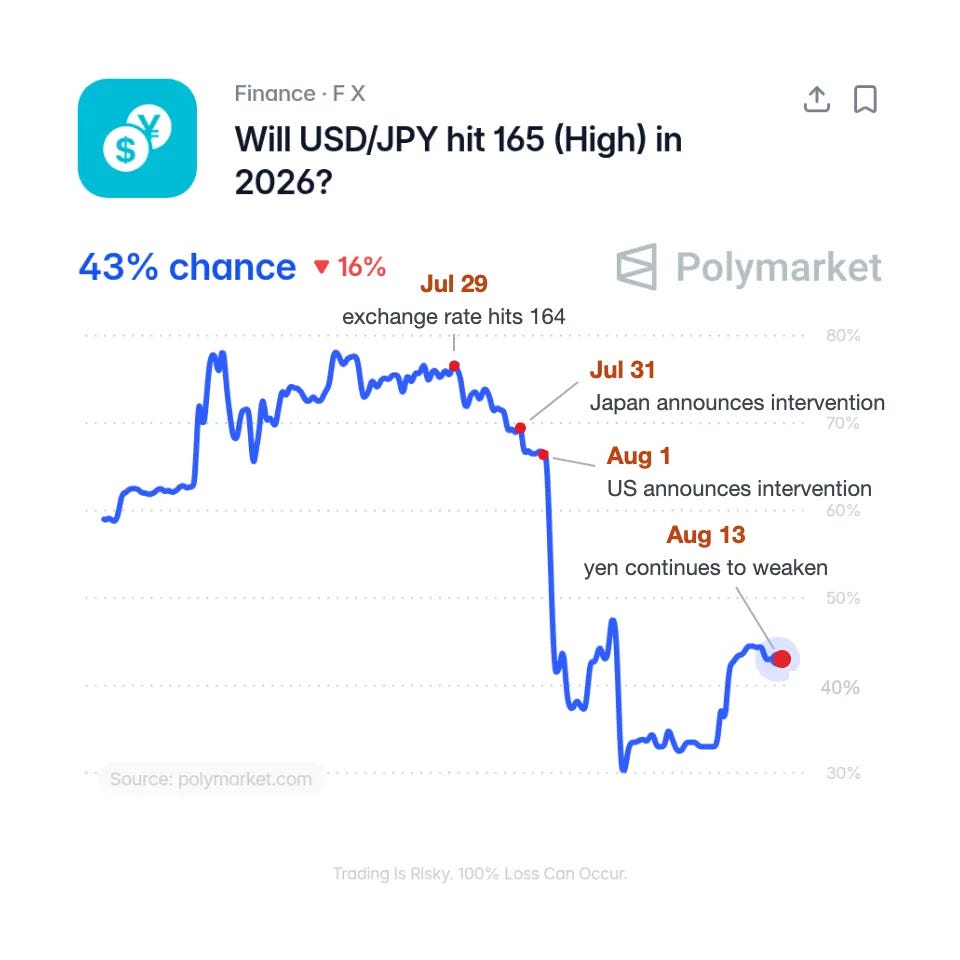
Polymarket traders have priced the ongoing slide in the past month. When the USD/JPY rate hit its peak of 164, odds of it topping 165 by year-end ran to around 77%. The US and Japan intervention knocked those odds to 30% in two days. But just two weeks later, they are back to 43%. Traders essentially shrugged off the intervention as merely buying time to avoid confronting an inevitable further decline in the yen.
Trigger warning
This is not the first round of jitters about a carry trade unwind; there was a similar episode in the summer of 2024.
When the Bank of Japan hiked to 25bp on July 31st, and jobs data on Aug 2 pulled US yields lower, the yen surged ~6% in just a few days. Margin calls went out on August 5th, crashing the Nikkei 12.4%, its worst decline in nearly 40 years and dragging U.S. stocks down with it.
The trigger in 2024 was the BoJ hiking rates 25bp off a floor of zero. Today, a BoJ hike is the market's base case. While traders priced a September hike only at 8% a few weeks ago, the intervention spiked the odds and sped up the repricing, now trading at 68%.
A September BoJ hike would take Japan’s policy rate to 1.25%, the third hike since December, and a pace not seen since 1989. With the Fed also expected to hold rates in September (75% odds), the carry trade spread would further compress.

Wall Street shrugs?
The stock market has not yet been thrown off by yen carry risk.
As we saw in 2024, equities are the first casualty of a carry trade unwind. Today the S&P sits around 7,800, and traders give 34% odds it tops 8,200 by December. In late July, the equities forecasts held steady even as the yen intervention collided with the Situational Awareness margin call. As both stresses faded, the market resumed its climb, even as the yen resumed sliding.
So while yen stress and AI stress hit the same index as leveraged players sold off, there is still optimism in the short-term resilience of the S&P. The tail risk that the S&P touches 6,200 by December has a 17% chance. If a September hike sends the yen sharply higher, the first signal may be a repricing of the S&P forward strip.

Treasuries impact
But a carry trade unwind would also have second-order effects beyond stocks.
Japan is the largest foreign holder of US Treasuries. By selling Treasuries to buy yen, Japan pushes US yields higher. Odds of the 10-year yield hitting 4.8% before 2027 reached near 70% the week of the intervention. Notably, Bessent funded his part of the intervention by selling Euros, knowing that the US Treasury market couldn’t absorb any more selling.
The yen intervention was supposed to protect the Treasury market. But every round of yen defense means Japan is selling more Treasuries to prop up its currency.
As the 10-year Treasury forecast creeps higher, Polymarket traders are forecasting the slow exit of the most reliable buyer of US debt.
The risk for the equity market is that Japan’s exit pushes US interest rates higher, squeezing the equity risk premium that thinly supports the stock market’s valuation.

September showdown
Polymarket forecasts for BoJ rates and US debt see a carry trade squeeze coming. Stock traders not so much.
These narratives will collide at the September meeting. A BoJ hike, if it snaps the yen sharply higher, would hit equities first and trigger cascading margin calls in a replay of the summer of 2024. A hold buys the carry trade another quarter, but how much lower can the BoJ let the yen slide?
Anton Wagner is studying Applied Math and Philosophy at Harvard University and is an intern on the Growth and Partnerships team at Polymarket.
Related Polymarkets:
Disclaimer
Nothing in The Oracle is financial, investment, legal or any other type of professional advice. All odds are time-sensitive and subject to change. Anything provided in any newsletter is for informational purposes only and is not meant to be an endorsement of any type of activity or any particular market or product. Terms of Service on polymarket.com prohibit US persons and persons from certain other jurisdictions from using Polymarket to trade, although data and information is viewable globally.
👀